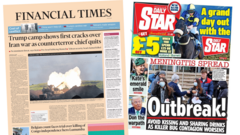
The facade of a unified front in Washington is peeling back to reveal a high-stakes power struggle over the future of Middle Eastern conflict, while across the Atlantic, British health officials are scrambling to contain a different kind of lethal threat. These two stories, seemingly worlds apart, share a common thread of institutional strain. In the United States, the long-standing hawkish consensus on Iran is meeting internal resistance for the first time in years. Simultaneously, the United Kingdom’s public health infrastructure is facing a test of its rapid-response capabilities as meningitis cases spike among vulnerable demographics.
Both situations represent a breakdown of the status quo.
The Internal War Over an Iran Conflict
For decades, the American approach to Tehran has been a predictable oscillation between economic strangulation and threats of kinetic action. However, the current atmosphere in the capital suggests that the "maximum pressure" campaign has reached a volatile tipping point where even the most seasoned advisors are beginning to blink. This isn’t a sudden shift toward pacifism. It is a pragmatic, internal realization that the logistical and political costs of a direct confrontation may now outweigh any perceived strategic gains.
The "first cracks" appearing in the inner circle represent a fundamental disagreement on the end goal. One faction remains committed to regime change through attrition. Another, increasingly vocal group, fears that an accidental escalation could trap the United States in a multi-front war that the public is unprepared to support and the Treasury is ill-equipped to fund. This internal friction has slowed the decision-making process, creating a vacuum where conflicting messages are being sent to both allies and adversaries.
The Cost of Miscalculation
History shows that military interventions rarely follow the script written in briefing rooms. The current hesitation stems from intelligence suggesting that any strike on Iranian infrastructure would trigger a regional domino effect. This isn't just about missiles. It involves the weaponization of global oil markets and the activation of proxy networks across three continents.
Advisors who once championed a hardline stance are now quietly questioning the exit strategy. There isn't one. Without a clear path to de-escalation, the "cracks" in the administration aren't just personality clashes; they are structural failures in a policy that has run out of road. The tension between the desire to project strength and the fear of a permanent, unwinnable conflict has left American foreign policy in a state of paralysis.
Britain’s Race Against a Biological Clock
While diplomats argue over maps and munitions, British medical authorities are fighting a battle where the enemy is microscopic. The recent surge in meningitis cases across the UK is more than a seasonal fluctuation. It is a red flag indicating gaps in the national immunization shield, particularly among young adults and university students who missed vital vaccinations during recent years of social disruption.
Meningitis remains a terrifying prospect for clinicians because of its speed. A patient can go from "flu-like symptoms" to organ failure or permanent neurological damage in less than twenty-four hours. The current outbreak is testing the National Health Service’s ability to move from detection to treatment without the usual bureaucratic friction that bogs down primary care.
The Geography of the Outbreak
The spread isn't uniform. Investigative data shows clusters forming in high-density student housing and urban centers where the uptake of the MenACWY vaccine has dipped below the threshold required for herd immunity. Public health officials are no longer just asking people to be aware of the signs; they are launching targeted, localized interventions to shore up immunity before the academic year progresses further.
The challenge is twofold. First, the symptoms of meningitis—fever, headache, and a stiff neck—are notoriously non-specific in the early stages. Second, the famous "glass test" for a non-blanching rash is often a late-stage sign. Waiting for the rash to appear is a gamble with a person’s life. Doctors are being urged to trust their clinical suspicion and start antibiotics early, even before hospital admission is finalized.
The Infrastructure of Crisis Management
The parallel between a fracturing political cabinet and a stressed health system is the reliance on clear communication. In Washington, the lack of a unified voice on Iran creates global instability. In the UK, any ambiguity in health messaging regarding meningitis leads to preventable deaths.
Health experts have noted that the public’s "warning fatigue" is a genuine obstacle. After years of constant health alerts, the urgency of a meningitis spike can get lost in the noise. To counter this, the current strategy involves direct engagement with student unions and community leaders to bypass traditional media channels that many younger people ignore.
Funding the Front Lines
Both the military-industrial complex and the healthcare system are currently fighting for a larger slice of the fiscal pie. The irony is that the cost of preventing a war or an epidemic is a fraction of the cost of managing the aftermath. A single meningitis patient requiring intensive care and long-term rehabilitation costs the taxpayer more than the vaccination of an entire school district. Similarly, the economic fallout of a closed Strait of Hormuz would dwarf the costs of sustained diplomatic engagement.
The cracks in the political sphere and the gaps in the health system are both symptoms of a short-term mindset. We prioritize the immediate fire over the structural fireproofing.
The Reality of Global Interdependence
The "The Papers" headlines often treat these stories as disparate events, but the investigative reality is that they are both tests of institutional resilience. When a government cannot agree on its primary foreign objective, its domestic priorities often suffer from a lack of focus. The resources diverted to a potential conflict are resources not spent on genomic sequencing for new bacterial strains or public health outreach.
The UK’s tackling of the meningitis outbreak requires a level of national coordination that is increasingly difficult to maintain in a polarized environment. It requires trust in official data and a willingness to follow collective health advice. When political leadership is seen to be fracturing over major issues like war, that trust trickles down and erodes the public’s confidence in other state-run initiatives, including vaccination programs.
Identifying the Next Pressure Points
For the United States, the next sixty days are critical. If the internal divisions over Iran are not resolved, the risk of a "policy by accident"—where a low-level commander's decision leads to a full-scale war—increases exponentially. The cracks must be mended or the policy must be fundamentally rewritten.
For the UK, the success of the current meningitis intervention will be measured in the "missing cases." Success in public health is invisible; it is the outbreak that never happened and the hospital beds that stayed empty. The focus remains on the 18-to-25 demographic, where the risk of transmission is highest and the vaccination rates have been most stagnant.
Necessary Action for the UK Public
If you or someone in your household is a student or a young adult, verify their MenACWY status immediately. Do not wait for a letter from a GP. The symptoms to watch for are not just the rash, but a sudden, intense aversion to bright lights and a headache that feels distinct from a standard migraine. Speed is the only factor that changes the outcome in a meningitis case.
Check your local health registry and ensure that all boosters are up to date, as the current strain circulating has shown a high rate of complications in those with partial or outdated immunity.