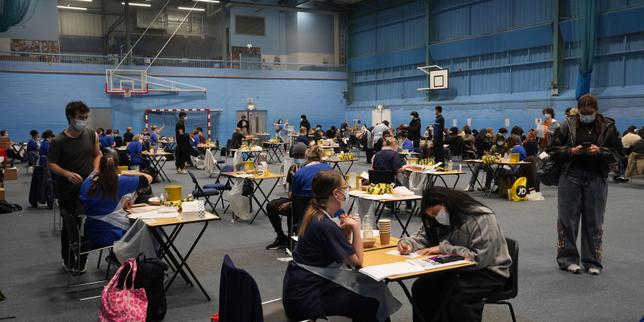
Liam didn't think much of the headache. It felt like the standard price for a late night spent studying under the buzzing fluorescent lights of a London library. He took two paracetamol, drank a glass of water, and waited for the world to stop throbbing. But by three in the morning, the walls of his dorm room seemed to be closing in. The light from his phone felt like a physical blow to his eyes. When he tried to tuck his chin toward his chest, his neck refused to bend. It wasn't just pain; it was a biological shutdown.
He is one of the lucky ones. He lived.
Across England, a silent, microscopic predator is reclaiming territory we thought we had walled off decades ago. The latest data from health authorities isn't just a collection of spreadsheets and trend lines; it is a map of a growing emergency. Meningitis cases are climbing. The numbers have shifted from a background hum to a roar, particularly among the young and the vulnerable. While we were distracted by the global fatigue of a different pandemic, this older, swifter killer found the gaps in our collective armor.
Meningitis does not negotiate. It is an inflammation of the protective membranes covering the brain and spinal cord, often triggered by a bacterial infection that can move from a slight shiver to organ failure in the time it takes to watch a movie. It is a thief of time.
The Mathematics of a Fever
To understand why the UK is now launching a massive, coordinated vaccination campaign, you have to look at the mechanics of how a community breathes. Bacteria like Neisseria meningitidis often live harmlessly in the back of the throat. Many of us are carriers, walking around with a loaded weapon we don’t even know we’re holding. We sneeze, we share a drink, we kiss a partner, and the bacteria migrates.
For most, nothing happens. But for the unlucky few, the bacteria breach the bloodstream.
Once they cross that threshold, the clock starts. $T = 0$.
The recent spike in cases isn't a fluke of nature. It is the result of a "protection gap." During the years of lockdowns and social distancing, our immune systems were essentially kept in a sterile bubble. We weren't swapping the usual germs that keep our natural defenses on high alert. Now that the world has opened back up—concerts are packed, lecture halls are full, and international travel has returned to its frantic pace—the bacteria are finding "immunologically naive" hosts.
Imagine a forest that hasn't seen a small, controlled fire in years. The undergrowth builds up. The dry wood piles high. When a single spark finally hits, the resulting blaze is far more intense than it would have been in a normal cycle. That is what England is facing right now. The spark has been struck.
The Rash That Doesn't Fade
There is a specific kind of terror that comes with the "tumbler test." Most parents in the UK know it by heart, but in the heat of a crisis, memory becomes a brittle thing. You take a clear glass, press it firmly against a red or purple rash on the skin, and wait. If the spots disappear under the pressure, you can breathe. If they stay—vivid, angry, and visible through the glass—the situation is a medical emergency.
That rash is the sign of septicemia, where the bacteria are effectively poisoning the blood and causing tiny hemorrhages under the skin.
But waiting for the rash is a dangerous game. By the time those marks appear, the infection is already winning. The experts leading the current vaccination drive are pushing a different message: don't wait for the spots. Trust the exhaustion. Trust the stiff neck. Trust the fact that the light hurts in a way you've never experienced.
The campaign currently rolling out across the country is focusing on the MenACWY vaccine. It’s a mouthful of a name that covers four different strains of the disease. In the past, we focused heavily on Type C, and we were successful. We nearly wiped it out. But biology is opportunistic. As Type C receded, other strains like Type W began to creep into the vacuum.
The Invisible Stakes of a Jab
Vaccination is often framed as a personal health choice, but in the context of meningitis, it is an act of social architecture. When a teenager gets their shot, they aren't just protecting their own brain; they are breaking a chain of transmission. They stop being a carrier. They become a dead end for the bacteria.
This is the "herd" in herd immunity, though that term feels too cold for what it actually represents. It represents the grandmother whose immune system is too frail to fight. It represents the infant who is too young to be fully jabbed. Every person who rolls up their sleeve is effectively building a levee to protect the entire town from a flood.
Right now, that levee has holes in it.
Uptake for routine immunizations dropped during the chaotic years of 2020 and 2021. GP surgeries were overwhelmed, and parents were hesitant to bring children into clinics. We are seeing the bill for that delay come due now. The increase in cases isn't just a statistic; it's a reflection of missed appointments and forgotten reminders.
The current operation is a race. Health officials are setting up pop-up clinics, sending frantic letters to households, and flooding social media with reminders. They are trying to reach the "lost cohort"—the young adults who missed their boosters during the height of the global disruption.
Why This Hurts More Than Other Ailments
There is a particular cruelty to meningitis. It targets the young—the toddlers exploring their world and the students just beginning to find their independence. It is a disease of proximity. It thrives on the very things that make us human: our desire to be close, to touch, to gather in crowded rooms and share experiences.
When you talk to survivors, they don't talk about "cases" or "strains." They talk about the "before" and the "after." They talk about the limbs lost to sepsis, the hearing that never came back, or the cognitive fog that made finishing a degree feel like climbing Everest.
The financial cost to the NHS is staggering, running into the millions for the long-term care of a single severe case. But the human cost is unquantifiable. It is the empty seat at the graduation ceremony. It is the silence in a nursery that should be filled with noise.
The Logic of the Needle
Some voice concerns about the speed of these rollouts or the necessity of "yet another injection." It is a natural reaction to a world that feels over-medicalized. But the logic of the meningitis vaccine is different from the seasonal flu or even the recent battles with respiratory viruses.
This is about a permanent defense against a permanent threat.
The bacteria don't care about your politics or your "vaccine fatigue." They are ancient, efficient, and entirely focused on replication. They have no motive other than to survive, and they do that by hopping from one throat to the next until they find a weakness.
The current operation in England isn't just a bureaucratic response to a rising line on a graph. It is a massive, collective effort to reclaim the safety of our public spaces. It’s about ensuring that a headache stays just a headache, and that a night of studying doesn't end in an intensive care unit.
Consider the silence of a hospital corridor at 4:00 AM. It is a heavy, pressurized quiet. In one room, a team of doctors is pumping high-dose antibiotics into a teenager's veins, hoping they were fast enough. In another, a family waits for news, their lives suspended in the balance.
Outside those walls, the rest of the world moves on, largely unaware that this battle is happening every day. We walk past the pharmacies and the GP surgeries, seeing the posters for the vaccination drive as just more background noise in an information-saturated world.
But that needle, and the fluid inside it, is the only thing standing between the vibrant, messy reality of our lives and the cold, clinical finality of the bacteria.
The rise in cases is a warning. It is the sound of the wind picking up before a storm. We have the tools to reinforce the roof and batten down the hatches. The clinics are open. The vials are ready. The only question that remains is whether we will wait for the rash to appear before we decide to act.
Liam made it. He walked out of the hospital, though his balance was off for months and his memory felt like a jigsaw puzzle with missing pieces. He tells his story now not for sympathy, but for awareness. He knows that his survival wasn't just a matter of medicine; it was a matter of minutes.
The next person might not have those minutes to spare.