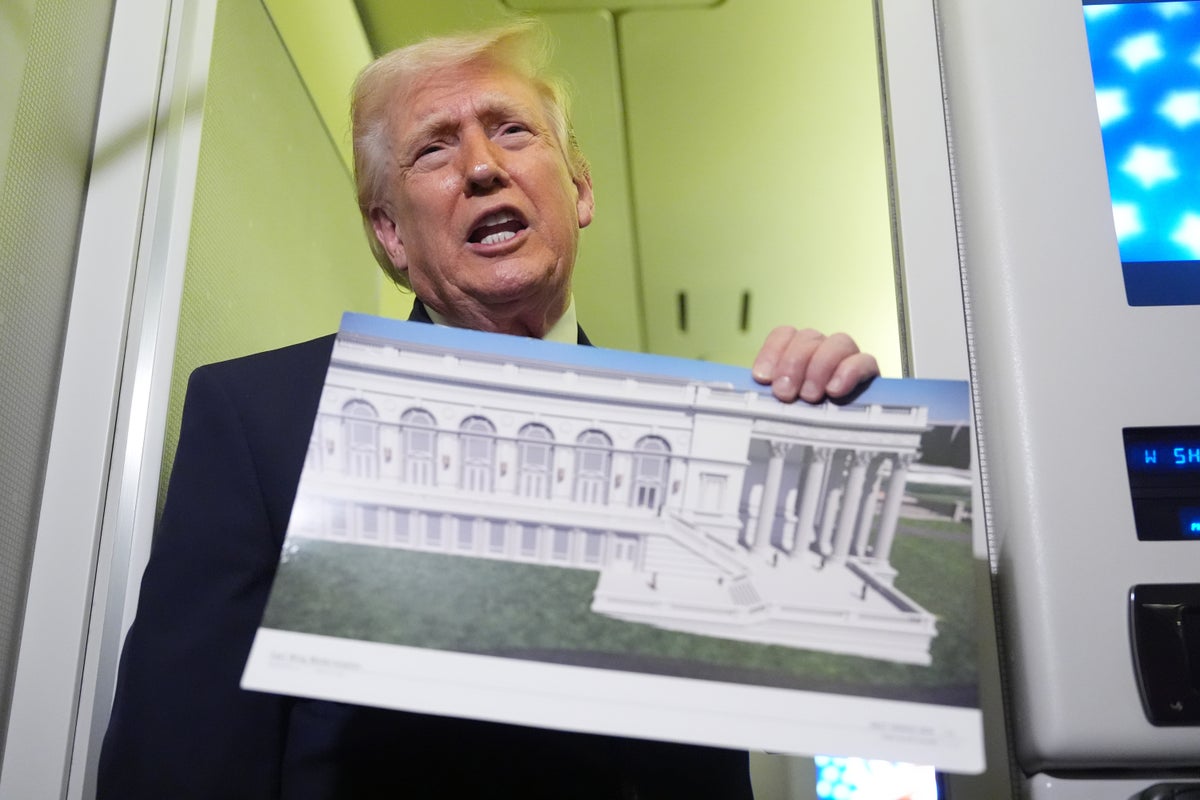
The Department of Justice's (DOJ) recent appellate filings regarding the construction of the White House ballroom shift the legal focus from aesthetic preference to operational necessity. This litigation hinges on a fundamental dispute: whether the 2017–2021 administration's renovations were discretionary luxury upgrades or essential mitigations of systemic facility failure. By characterizing the East Wing as "infested" and "dilapidated," the government's legal strategy moves beyond political justification into the realm of federal procurement law and facility management standards.
The Categorization of Facility Decay
The DOJ’s argument relies on a three-tier framework of structural obsolescence to justify the speed and scale of the ballroom project. This framework determines the level of oversight required and the legal immunity of the decision-makers involved.
- Sanitary and Health Risks: The claim of "infestation" suggests a breach of the basic habitability standards expected of a Tier 1 federal facility. In structural management, pest and mold issues are not merely cosmetic; they represent a failure of the building envelope. If the East Wing’s barriers were compromised, the necessity for immediate intervention overrides standard long-term budgetary cycles.
- Structural Instability: "Dilapidation" implies that the load-bearing or foundational elements of the East Wing were nearing a point of terminal utility. The government’s defense focuses on the "discretionary function" exception to the Federal Tort Claims Act, arguing that officials must have the latitude to address rapid physical degradation without the threat of retrospective litigation over the specific design choices made during the repair.
- Operational Inefficiency: The existing infrastructure lacked the capacity to support modern high-security, high-density events. This creates a "utility gap" where the cost of maintaining an obsolete structure exceeds the cost of a total renovation.
The Discretionary Function Doctrine as a Shield
The core of the legal battle is not whether the ballroom is attractive, but whether the government had the right to build it under the Discretionary Function Exception. This legal principle protects federal employees from lawsuits when their actions involve an element of judgment or choice grounded in social, economic, or political policy.
The government’s strategy follows a two-pronged logical path to invoke this protection:
- The Judgment Prong: The officials had to choose between incremental repairs (which might not solve the underlying decay) and a comprehensive overhaul. The DOJ argues this choice is exactly the type of "judgment" the law protects.
- The Policy Prong: The decision was based on national security and diplomatic policy. Hosting foreign dignitaries in a "dilapidated" environment creates a soft-power deficit and potential security vulnerabilities. Therefore, the renovation was a tool of statecraft, not just interior design.
The opposition’s counter-argument seeks to prove that the renovation violated specific, mandatory federal regulations regarding historic preservation. If a specific "shall" or "must" directive existed that prohibited the destruction of certain East Wing elements, the discretionary shield evaporates.
Quantifying the Infestation Claims
The use of the term "infested" serves a specific evidentiary purpose. Within the context of federal property management, an infestation provides a biological basis for emergency procurement.
The East Wing, originally constructed in its current form in 1942, sits atop complex utility tunnels and historical foundations. These areas are prone to moisture ingress and vermin incursions if the structural seals are breached. The DOJ's filings suggest that the "dilapidation" was not a surface-level issue but an systemic failure of these seals.
If the government can produce maintenance records from the 2017–2020 period showing repeated, failed attempts to remediate pest and structural issues through standard means, the "dilapidation" claim becomes an objective fact rather than a subjective description. This shifts the burden of proof to the plaintiffs, who must then prove that a less-intrusive method could have achieved the same sanitary and structural standards.
The Economics of Presidential Renovation
Critics often view White House renovations through the lens of excess. However, a rigorous analysis of federal facility life cycles suggests a different cost function.
- The Maintenance Premium: Older federal buildings often have a maintenance premium of 200% to 300% above modern equivalents. When a building reaches this stage of the "S-curve" of decay, the cost of repair begins to accelerate exponentially.
- The Opportunity Cost of Space: The White House is a fixed-volume asset. Every square foot that is unusable due to "dilapidation" is a loss of high-value real estate in the world’s most significant command center.
The DOJ’s appeal emphasizes that the decision to build a ballroom was a method of reclaiming lost space. By consolidating event functions into a modernized, purpose-built area, the administration theoretically reduced the wear and tear on the more fragile, historical state rooms of the Main Residence.
Legal Precedent and the Burden of Proof
The appellate court must now decide if "dilapidation" is a subjective opinion or a legally defensible state of fact. If the court accepts the DOJ’s description, it sets a high bar for future challenges to White House renovations.
The legal mechanism at play is Auer Deference or similar principles of administrative law, where courts often defer to an agency’s interpretation of its own operational needs. In this case, if the agency responsible for the White House grounds—likely the National Park Service or the General Services Administration—concurred that the East Wing was in a state of terminal decline, the court is unlikely to second-guess that expert assessment.
The plaintiff's struggle lies in the asymmetry of information. The government possesses the physical survey data, the pest control logs, and the structural engineering reports. Unless the plaintiffs can access discovery that contradicts the "infested" and "dilapidated" narrative, the government's categorization of the project as a necessary mitigation will likely stand.
Strategic Implications for Federal Property Law
This case transcends the specifics of the ballroom. It establishes a precedent for how federal properties of historical significance are managed under pressure.
- Historic Preservation vs. Operational Utility: The tension here is between the National Historic Preservation Act (NHPA) and the operational requirements of the presidency. The DOJ is effectively arguing that operational utility—driven by physical decay—supersedes preservation protocols.
- The Definition of Emergency: By using the term "infested," the DOJ is attempting to broaden the definition of a facility emergency. This could allow future administrations to bypass lengthy review processes by documenting biological or structural hazards.
- Immunity for Aesthetic Outcomes: If the government wins, it confirms that as long as a project can be justified by "structural need," the resulting aesthetic or functional outcome (such as a ballroom) is largely immune from judicial review.
The final determination will hinge on whether the "infested" state of the East Wing was a pretext for a desired renovation or a genuine catalyst for it. If the evidentiary record shows that the decay was pre-existing and severe, the "dilapidated" argument becomes a formidable legal defense that secures the project's legitimacy under federal law.
The government must now pivot from rhetorical descriptions to the presentation of hard structural data. Success in the appellate court requires a transition from the language of "infestation" to the language of "mechanical systems failure" and "envelope breach." Documentation of failed HVAC systems, compromised floor joists, and recurring biological incursions will be the deciding factors in maintaining the discretionary function shield.
The court’s ruling will ultimately dictate the degree of autonomy any administration possesses to fundamentally alter the White House footprint based on their own assessment of the facility’s physical integrity.