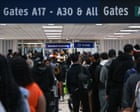
The surge in Transportation Security Administration (TSA) unscheduled absences—colloquially termed "call outs"—represents more than a localized staffing hurdle; it is a critical failure point in the high-velocity supply chain of civil aviation. When absenteeism spikes at tier-one hubs, the resulting friction cascades through the entire air transport ecosystem, inflating wait times, degrading security efficacy, and straining the economic throughput of the travel sector. This volatility stems from a misalignment between rigid federal staffing models and the fluctuating labor dynamics of a post-pandemic workforce.
The Triple Constraint of Aviation Security
To understand why a 5% or 10% increase in call outs triggers disproportionate delays, one must evaluate the TSA operational model through the lens of the Triple Constraint: Throughput, Security Integrity, and Resource Allocation.
- Throughput Elasticity: Airport checkpoints are designed for steady-state flow. They possess limited "buffer capacity." Once the arrival rate of passengers exceeds the processing rate of the available lanes, the queue length grows exponentially rather than linearly.
- Security Integrity Standards: Unlike private sector manufacturing, a security checkpoint cannot "lower the quality" of the scan to move the line faster. Standard Operating Procedures (SOPs) are static. If a lane lacks the mandatory number of certified Officers (TSOs), that lane must remain closed.
- Resource Rigidity: Federal labor pools are not agile. A shortage in Terminal A cannot always be solved by moving staff from Terminal B due to specific terminal badges, union rules, or logistics of scale.
When call outs rise, the TSA loses the ability to open "overflow" lanes during peak windows (05:00–08:00 and 16:00–19:00). The system loses its elasticity, turning a minor staffing deficit into a terminal-wide bottleneck.
The Economic Cost Function of Absenteeism
The narrative often focuses on "passenger frustration," but the true impact is quantified through the Cost of Dwell Time. For every additional 10 minutes a passenger spends in a security queue, there is a measurable decline in "airside" spending—revenue generated at restaurants and retail shops past the checkpoint.
For the airline, the cost function is even more severe. High call out rates lead to:
- Gate Holds: Delayed passengers force gate agents to choose between "taking the delay" to board missing travelers or offloading bags, both of which incur ground handling costs.
- Missed Connections: At hub airports like Hartsfield-Jackson (ATL) or Dallas/Fort Worth (DFW), a security bottleneck in the morning ripples into missed flight segments in the afternoon, requiring expensive rebooking and "distressed passenger" vouchers.
- Labor Burnout: The remaining staff must work at 100% utilization for extended periods, which accelerates the feedback loop of exhaustion, leading to further call outs and higher turnover.
Root Cause Mapping: Why Call Outs Cluster
Unscheduled absences are rarely random. They follow specific triggers that the current federal management structure struggles to mitigate.
The Compensatory Gap
While the TSA has implemented pay increases in recent fiscal cycles, the role of a TSO remains a high-stress, high-compliance position. In markets with low unemployment, the "opportunity cost" for an officer to stay in the role decreases. If a local private-sector warehouse offers similar pay with 20% less physical and mental strain, the incentive to report for a grueling shift at a shorthanded checkpoint diminishes.
Geographic Concentration
Call outs tend to cluster in "High-Cost-of-Living" (HCOL) zones. In cities like New York, San Francisco, or Miami, the delta between a federal salary and the cost of commuting/living is thin. When an officer faces a personal or family logistics issue, the financial penalty of a missed shift is often outweighed by the sheer difficulty of maintaining the role in an expensive urban center.
Seasonal Fatigue and Pathogen Loading
Data suggests that spikes often align with the tail end of peak travel seasons (e.g., post-Spring Break or late August). This is the "Fatigue Threshold," where the cumulative stress of managing record-breaking passenger volumes leads to a breakdown in physical health or morale. Furthermore, the high-density nature of checkpoints makes TSOs "canaries in the coal mine" for seasonal respiratory illnesses, which can take out a significant percentage of a shift's workforce simultaneously.
The Mechanics of the "Sick-Out" vs. Organic Attrition
It is essential to distinguish between organized "sick-outs" (labor actions) and organic absenteeism. While organized labor actions are prohibited for federal employees under the Lloyd-La Follette Act, decentralized "frustration-based absenteeism" produces the same operational result.
When a TSO perceives that the system is failing—that they will be asked to do the work of two people for the third day in a row—the psychological barrier to calling out vanishes. This is a contagion effect. If Officer A sees that the checkpoint is already understaffed and chaotic, the "marginal pain" of their absence feels lower, even though it actually compounds the crisis for those remaining.
Structural Vulnerabilities in Current Contingency Planning
The TSA utilizes National Deployment Forces (NDF)—a "flying squad" of officers sent to bolster airports in crisis. However, the NDF is a reactive mechanism, not a preventative one.
- Latency: It takes 24 to 72 hours to deploy NDF assets. By the time they arrive, the peak delay event has often passed, or the local staff has already reached a breaking point.
- Knowledge Gap: Temporary staff are unfamiliar with the specific layout and local flow of a guest airport, leading to lower efficiency compared to "home" teams.
- Scalability: The NDF is sized for emergency surge, not for propping up daily operations at five or six major hubs simultaneously.
Quantifying the "Wait Time Paradox"
A common misconception is that doubling the staff will halve the wait time. In queuing theory, specifically Little’s Law, the relationship is more complex.
$$L = \lambda W$$
Where $L$ is the number of passengers in the queue, $\lambda$ is the arrival rate, and $W$ is the average time spent in the system.
When call outs occur, the "service rate" ($\mu$) drops. If $\lambda$ (passenger arrival) approaches $\mu$ (processing capacity), the queue $W$ does not just grow; it tends toward infinity. This explains why a seemingly small 10% drop in staffing can lead to a 300% increase in wait times during a Monday morning rush. The system moves from a state of "stable flow" to "stagnant accumulation."
Strategic Mitigation for the Travel Ecosystem
To stabilize the system, the TSA and airport authorities must move beyond reactive hiring and toward structural resilience.
Predictive Labor Analytics
The TSA must integrate local labor market data and health trends into its staffing algorithms. If a local flu outbreak is detected or a competitor (e.g., a major logistics firm) opens a new facility nearby, the "predicted call out rate" should be adjusted upward, and overtime should be pre-authorized to ensure a buffer is in place before the shift begins.
Tiered Compensation for "High-Friction" Shifts
Implementing a "surge pay" model for shifts known to have high call out rates—such as holiday weekends or 4:00 AM starts—would align the officer's financial incentive with the operational need. Currently, a federal salary is too "flat" to account for the variable stress of these windows.
Accelerated Automation (Credential Authentication Technology)
The long-term solution to absenteeism is reducing the "labor-to-passenger ratio." Expanding CAT-2 systems, which allow passengers to self-verify identity without a TSO manually checking a physical ID, shifts the human resource requirement from "routine processing" to "high-value screening."
The Perimeter Strategy
Airports must take a more active role in the "Employee Experience" of federal staff. This includes providing dedicated, low-cost transit for TSOs, subsidized on-site childcare, and better break-room infrastructure. When the airport environment is hostile to the worker, the worker is less likely to show up for the shift.
The stability of the U.S. aviation network depends on the realization that the TSA is not just a regulatory body, but a labor-intensive logistics firm. Until the agency adopts the workforce management sophistication of a global logistics giant, the "call out" will remain the most significant unhedged risk in the travel industry.
Strategic recommendation: Airport operators should immediately establish a "Joint Operational Resilience Fund" to subsidize local-level benefits for federal screeners, decoupling TSO retention from the limitations of the national federal pay scale.