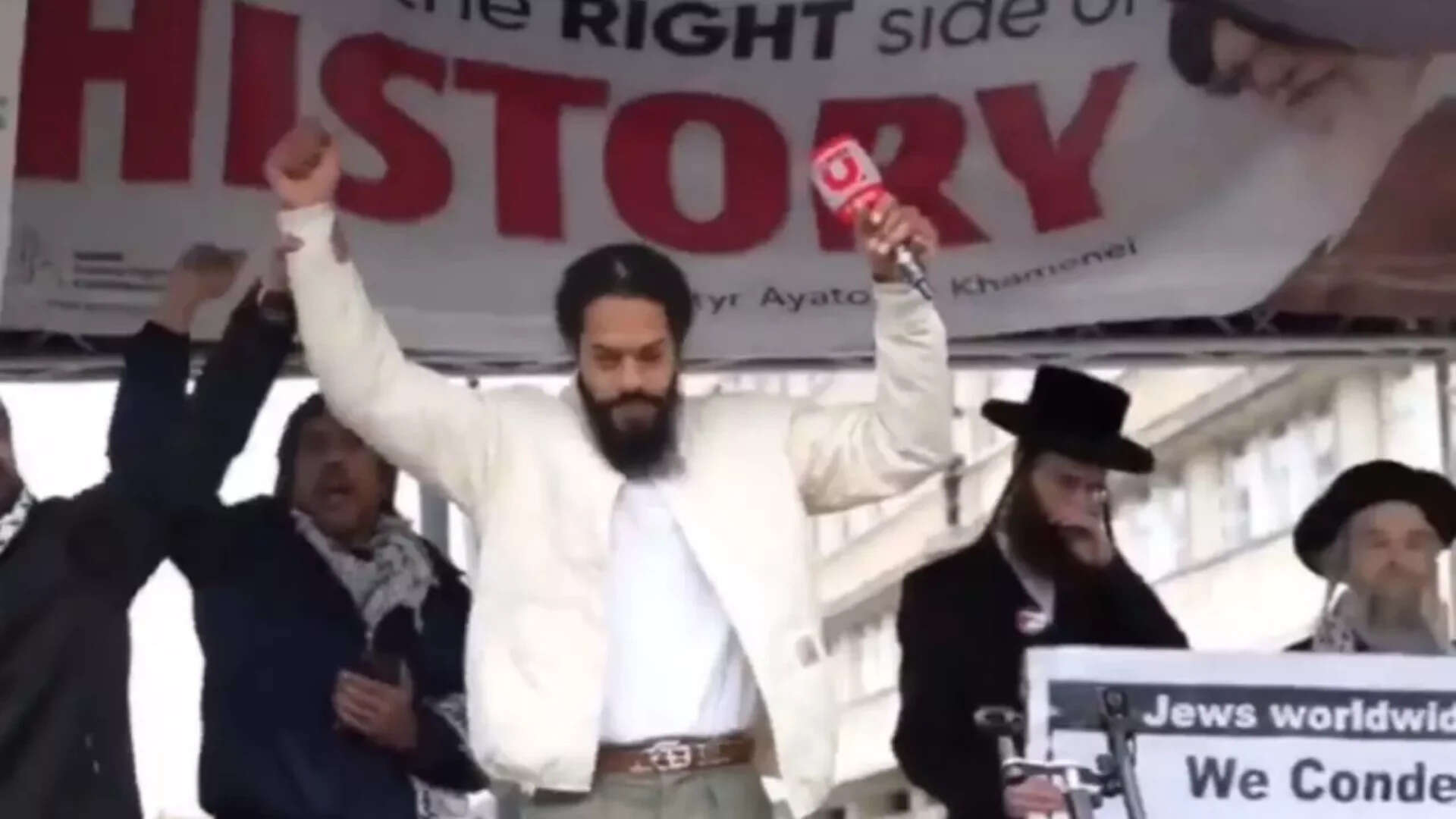
The air in London during a protest doesn’t just sit; it vibrates. It carries the scent of damp asphalt, cheap coffee from nearby kiosks, and the metallic tang of collective adrenaline. On a gray afternoon at an Al-Quds Day rally, the vibration changed. It sharpened. A man stood before a sea of faces, his voice cutting through the ambient hum of a city that usually tries to ignore its own fringes.
That man was Bobby Vylan. You might also find this similar story insightful: Radiohead Tells ICE to Stop Using Their Music.
To some, he is a poet of the dispossessed. To others, he is a dangerous instigator. But to understand the friction he creates, you have to look past the headlines and into the sweat-soaked reality of the UK’s underground punk-grime crossover. This isn't just about a chant. It’s about how a kid from the margins became the megaphone for a generation that feels it has nothing left to lose.
The Architect of the Noise
Bobby Vylan isn't a singular person. He is half of Bob Vylan, a duo that has spent the last few years systematically dismantling the polite boundaries of British music. They don't play for the industry. They play against it. When they won a MOBO award, they didn't just thank their moms; they stood as a testament to independent survival in a world that demands artists sell their souls for a spot on a curated playlist. As extensively documented in latest reports by Entertainment Weekly, the results are notable.
He represents a specific kind of Britishness—one that is uncomfortable, loud, and unapologetically black. It’s the Britishness born in the shadow of council estates and under the weight of "stop and search" statistics. When Bobby speaks, he isn't just articulating a political position. He is venting a lifetime of being told to wait his turn, to speak more softly, to be more "reasonable."
Reason, however, is a luxury.
The Moment the World Noticed
The Al-Quds Day rally in London is never a quiet affair. It is a flashpoint. In early 2024, the tension was already at a breaking point due to the ongoing devastation in Gaza. Bobby Vylan stepped into this crucible. He didn't just attend; he led. The footage captured him leading a chant that called for "death to the IDF."
The reaction was instantaneous.
Mainstream media outlets, which had largely ignored the nuanced critiques of systemic racism in his music, suddenly found their "gotcha" moment. The narrative shifted from a musician exploring social justice to a radical figure inciting violence. But if we only look at the words of the chant, we miss the terrifyingly complex human emotion driving it.
Consider a hypothetical young person in that crowd. Let’s call him Elias. Elias has spent months watching grainy, vertical videos on his phone—images of children pulled from rubble, of white phosphorous trails over civilian neighborhoods, of a world that seems to have outsourced its conscience. When Elias hears Bobby Vylan scream, he doesn't hear a military directive. He hears a release of the suffocating helplessness that has been crushing his chest for weeks.
This doesn't make the words less inflammatory. It makes them more human.
The Business of Being a Target
In the music industry, there is a safe way to be a rebel. You can wear the right leather jacket, sign to a major label, and let a PR team vet your tweets. Bobby Vylan took the other path. By remaining independent, he and his partner, Bobb13 Vylan, bypassed the gatekeepers. This gave them total creative freedom, but it also removed the shield that usually protects stars from the fallout of their own convictions.
When you are independent, you are the only one holding the lightning rod.
The backlash to the Al-Quds rally wasn't just about a specific phrase. It was an attempt to define the limits of protest. For years, the UK has been tightening the noose around public dissent. New laws have made "annoying" protests a criminal offense. In this environment, an artist like Bobby Vylan isn't just a singer; he is a glitch in the system of managed silence.
He knows the stakes. He knows that every time he speaks, he risks the festivals, the radio play, and the financial stability he fought so hard to build. Yet, he continues. There is a raw, almost frightening sincerity in that choice. It asks the listener a question: What do you actually believe in when the cameras aren't rolling?
The Roots of the Rage
You cannot understand the "death to the IDF" chant without understanding the "Price of Life." That’s the title of their breakout album, and it’s a thesis statement for their existence. The lyrics deal with the rising cost of rent, the lack of healthy food in poor neighborhoods, and the constant, low-grade fever of state surveillance.
Bobby Vylan’s worldview is one where the local and the global are inextricably linked. To him, the police officer in South London and the soldier in a foreign land are different chapters of the same book. It’s a perspective rooted in intersectionality—the idea that all forms of oppression are connected.
This is where the friction with the mainstream becomes permanent. Most people want their music to be an escape. They want to hear about heartbreak or partying or, at most, a very vague and non-threatening brand of "unity." Bobby Vylan offers the opposite. He offers a mirror that reflects the ugly, jagged parts of the world we’d rather ignore.
He is the personification of the "angry black man" trope that society loves to fear and hates to listen to. But if you strip away the fear, what’s left is a profound sense of grief. It is the grief of watching the world burn while the people in power argue over the temperature of the flames.
Beyond the Viral Clip
Social media is where nuance goes to die. A thirty-second clip of a chant can travel the world before the context even has time to put its shoes on. For many, Bobby Vylan is now defined by that single afternoon in London. He has been filed away in the "extremist" drawer, a convenient label that allows people to stop engaging with his art.
But the art remains.
If you listen to the songs, you hear a man who is deeply invested in his community. You hear someone who advocates for physical health, for mental clarity, and for the radical act of self-love in a society that tells you that you are disposable. This is the paradox of Bobby Vylan: he can lead a chant of "death" while simultaneously preaching a gospel of life and survival for his people.
The conflict isn't just between a rapper and the state. It’s between two different versions of reality. One reality says that we must maintain decorum at all costs—that even in the face of immense suffering, our language must remain sterilized and professional. The other reality, the one Bobby inhabits, says that decorum is a lie used to mask the screams of the dying.
The Weight of the Mic
Being a voice for the voiceless is a heavy burden. It’s also a dangerous one. History is littered with artists who spoke too loudly and were silenced—not just by the law, but by the exhaustion of being the permanent antagonist.
Bobby Vylan seems to thrive in this space, but there is a visible toll. You can see it in the way he performs, every muscle tensed, every word spat out as if it were a physical weight he needed to eject. This isn't a performance for him. It’s an exorcism.
The Al-Quds rally was just one moment in a much longer, much louder career. It won't be the last time he causes a scandal. It won't be the last time he forces us to look at something we'd rather turn away from. Whether you find him inspiring or abhorrent, you cannot deny his presence.
He is the static in the signal. He is the crack in the porcelain. He is the reminder that as long as there is injustice, there will be someone willing to scream about it, even if it costs them everything.
The rally ended. The crowds dispersed into the London evening. The banners were folded, and the police moved on. But the echoes of the chant remained, hanging in the air like smoke. Bobby Vylan walked away from the podium, back into the city that made him, leaving behind a trail of questions that no headline can satisfy.
The silence that followed wasn't peace. It was just the indrawn breath before the next shout.