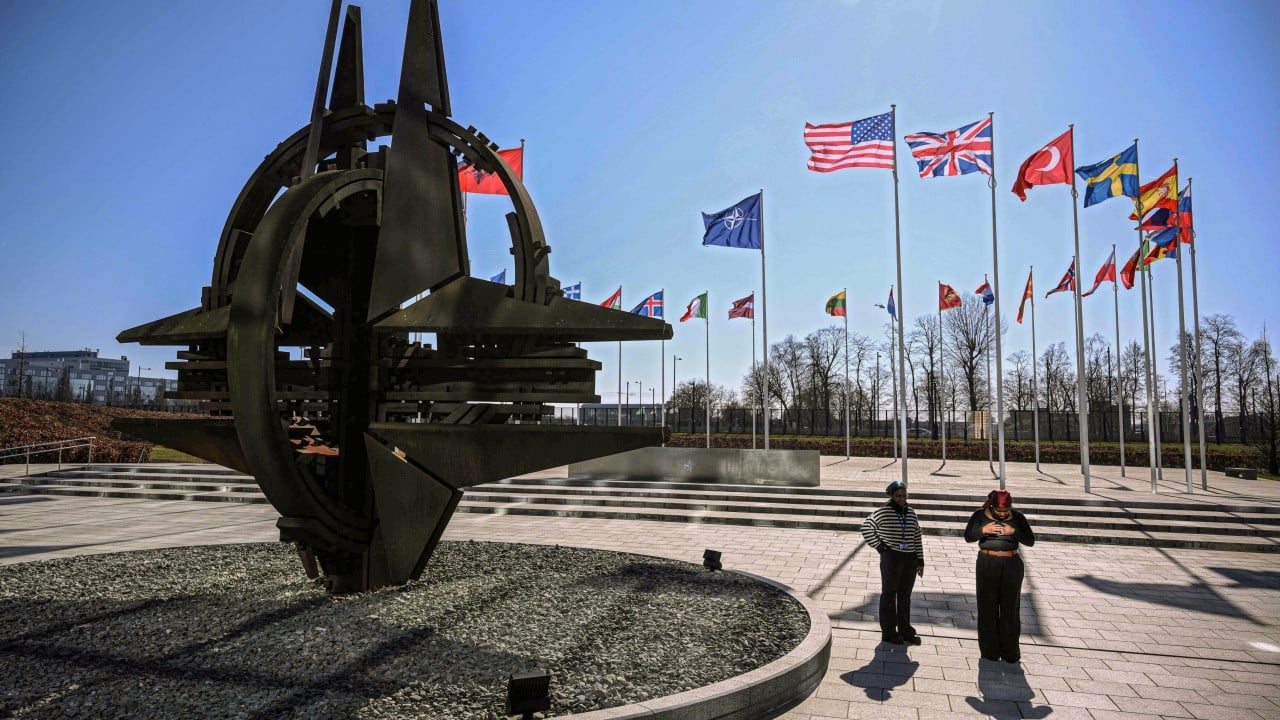
The air in the secure briefing rooms of Brussels doesn't smell like history. It smells like industrial carpet cleaner and over-steeped coffee. But as the delegates from the Chinese People’s Liberation Army (PLA) sit across from their counterparts at NATO and the European Union this week, the atmosphere carries a weight that no ventilation system can scrub away. Everyone in the room is looking at the same map, but they are all seeing different ghosts.
For years, these meetings were bureaucratic theater. They were the "deconfliction" sessions where generals discussed maritime safety or UN peacekeeping with the stiff, practiced politeness of neighbors who share a fence but never a meal. That era ended when the first missiles streaked across the sky over Isfahan and the Galilee.
The conflict in the Middle East has ceased to be a regional tragedy. It has become a global laboratory.
While the world watches the humanitarian devastation and the terrifying exchange of fire between Israel and Iran, the military strategists in Beijing and the defense analysts in Mons are looking at the data. They are watching how cheap drones swarm billion-dollar defense systems. They are analyzing how quickly a global supply chain can be choked at a single narrow strait. Most importantly, they are realizing that the old rules of engagement—the ones written in the aftermath of the Cold War—have been burned to a cinder.
The Invisible Observer
Consider a hypothetical officer in the PLA’s Strategic Support Force. We will call him Colonel Zhao. He is not a warmonger. He is a mathematician. In his office in Beijing, he isn't dreaming of conquest; he is calculating the "cost-exchange ratio."
Every time an Iranian-made Shahed drone forces a Western-aligned military to fire a multi-million-dollar interceptor missile, Zhao updates his spreadsheet. He sees that the West’s "exquisite" technology is being bled dry by the "good enough" technology of their adversaries. When he arrives in Europe for these talks, he isn't there to apologize for China’s "no-limits" partnership with Russia or its quiet diplomatic dance with Tehran. He is there to see if the Europeans have realized the same thing he has: the West’s umbrella is leaking.
The Europeans, meanwhile, are gripped by a different kind of vertigo. For decades, the EU treated security as something you bought from the Americans or outsourced to international law. Now, with the U.S. distracted by the fire in the Middle East and a domestic political cycle that looks more like a fever dream every day, the Continent is waking up to a cold reality. If the Middle East explodes, the energy prices in Berlin skyrocket. If the Red Sea closes, the factories in Lyon stop.
The "China-NATO" dialogue is no longer about hypothetical scenarios in the South China Sea. It is about the immediate, grinding reality of a world where every conflict is connected by a thousand invisible threads of trade, silicon, and crude oil.
The Physics of Power
The shift we are witnessing is a move from a unipolar world to one defined by "fragmented deterrence."
In the old model, the U.S. was the policeman. If you broke the rules, the policeman showed up. In the new model, there are no policemen—only gangs and neighborhood watch groups. China’s presence in Brussels is a signal that they intend to be the head of the largest watch group in the East. They are not coming to the table as subordinates to the "rules-based order." They are coming as the architects of a new one.
The math is simple and brutal.
- Kinetic energy is cheaper than it used to be.
- Information is more volatile than ever.
- The distance between "regional skirmish" and "global collapse" has shrunk to the width of a fiber-optic cable.
When the PLA delegation discusses "global security architecture" with NATO, they are really talking about the terms of a divorce. They are negotiating how to stay out of each other's way while the old house burns down. The tension in the room stems from a single, unacknowledged fact: China has watched the West struggle to contain Iran and Russia simultaneously, and they have reached a conclusion. They believe the West is tired.
The Human Toll of Logistics
We often talk about geopolitics as if it were a game of Risk played by giants. It isn't. It is a story about a shopkeeper in Antwerp who can’t get the parts he needs for a customer’s car because a Houthi rebel—using technology that can be traced back to a design shared between Tehran and Beijing—hit a container ship. It is about a student in Shanghai who wonders if her future will be defined by the "Great Rejuvenation" her government promises or by the staggering cost of a war she never asked for.
The talks in Brussels are an attempt to stop these stories from ending in a scream.
But there is a fundamental disconnect. NATO wants China to use its influence to "restrain" Iran and Russia. They want Beijing to act as a responsible stakeholder in the system the West built. China, however, sees that system as a cage. From their perspective, why would they fix a system that was designed to keep them in second place?
Instead, they offer a "Global Security Initiative." It sounds peaceful. It sounds inclusive. But look closer. It is a blueprint for a world where "sovereignty" means a big power can do whatever it wants in its own backyard without the "interference" of human rights or international courts. When the PLA officials speak to the EU, they are selling a vision of stability through strength, not stability through law.
The Ghost at the Table
The most important person at the meeting in Brussels is the one who isn't there: the American voter.
Both the Chinese and the Europeans are obsessed with what happens in Washington. If the U.S. retreats into isolationism, NATO becomes a hollow shell. If the U.S. doubles down on a "Pivot to Asia" while the Middle East is still on fire, they risk a systemic collapse.
China’s strategy is built on the bet that the U.S. cannot do everything at once. They are in Brussels to gauge the "strategic autonomy" of Europe. They want to know: if the Americans leave, will the Europeans fight, or will they deal?
The Iranian conflict has served as the perfect stress test. It has shown that the global energy market is incredibly fragile. It has shown that "advanced" Western navies struggle to protect shipping against asymmetric threats. Most of all, it has shown that the "Rest of the World"—the Global South—is increasingly uninterested in taking sides in what they see as a Western civil war.
The Coldest Comfort
As the meetings wrap up, there will be a joint statement. It will be filled with words like "constructive," "candid," and "mutual understanding."
Do not believe them.
The real takeaway is the silence. The silence of the realization that we are living in the "interregnum"—the period between the death of one world order and the birth of another. In this space, accidents happen. Miscalculations become catastrophes.
The Chinese military is not in Brussels to seek peace in the way a pacifist seeks it. They are there to manage the transition. They are mapping the terrain of a world where the U.S. is no longer the undisputed protagonist.
We are moving toward a future where "security" is no longer a shared goal, but a hoarded resource. The talks are not about building bridges; they are about checking the structural integrity of the walls.
The tragedy of the modern era is that we have more ways to communicate than ever before, yet we have never been further from understanding one another. The delegates will fly home. The drones will continue to buzz over the deserts of the Middle East. And the shopkeeper in Antwerp will continue to wait for a shipment that might never arrive.
The map is red. The coffee is cold. The ghosts are winning.
Would you like me to analyze the specific military technologies mentioned in the Chinese "Global Security Initiative" and how they compare to NATO's current capabilities?