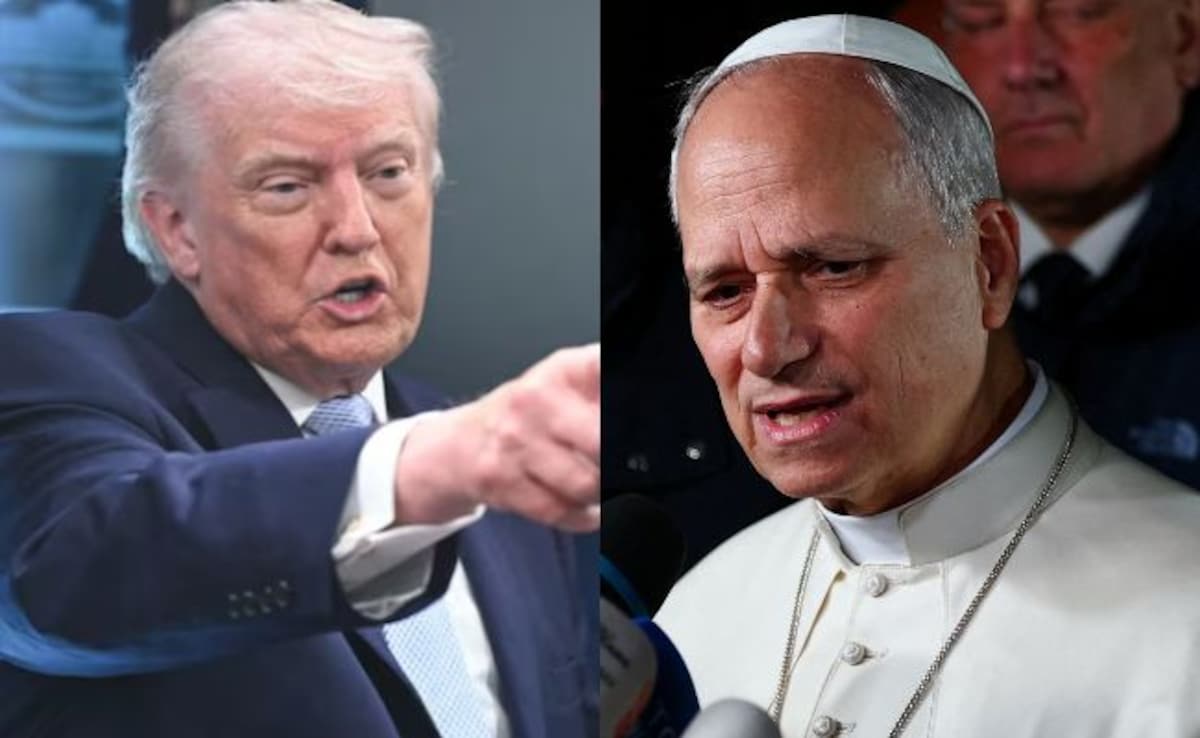
The air in the room usually shifts before the words even land. It is a specific kind of atmospheric pressure, the sort that precedes a summer storm or a sudden, sharp intake of breath. When Donald Trump speaks, he isn’t just delivering information; he is painting a mural of loyalty and grievance in real-time. But this time, the brush dipped into a different ink. This time, the target wasn’t a political rival in a suit or a media personality in a studio. It was a man in white robes, standing on a balcony thousands of miles away.
"Not a big fan of Pope Leo." You might also find this related coverage insightful: The Steel Ring Around the Persian Gulf.
The phrase sounded casual, almost like a throwaway comment about a neighbor who let his lawn grow too long. But in the theater of high-stakes diplomacy and the visceral world of international conflict, there are no throwaway comments. There is only the signal and the noise. To understand why a sitting American president—or a former one eyeing the seat again—would take a jab at a historical or religious figurehead after a brush with global war, you have to look past the headlines and into the messy, human heart of how power actually speaks to itself.
Consider the weight of a decision. Imagine standing at the precipice of a conflict with Iran, a nation whose history with the West is a tangled web of ghosts and gasoline. The stakes are not abstract. They are measured in the vibration of jet engines and the quiet prayers of families in dorm rooms and bunkers. When the dust settles on a moment of extreme tension, the human instinct is to exhale. But for a leader who built an empire on the architecture of the "deal," an exhale is often a pivot. As extensively documented in latest articles by Al Jazeera, the effects are significant.
The criticism of the Iran situation had been mounting. Voices from the rafters—religious leaders, diplomats, the old guard of the Vatican—had peered over their spectacles to offer a moral weighing of the scales. They spoke of peace as a static virtue. Trump, however, views peace as a negotiated commodity, a prize won through the sheer force of personality and the willingness to walk away from the table.
When the critique came from the direction of the Holy See, it hit a specific nerve. It wasn’t just about policy; it was about the audacity of an outsider telling a builder how to secure the perimeter. The "Pope Leo" remark—likely a linguistic slip or a conflation of the various Leos who have occupied the chair of St. Peter—wasn’t a history lesson. It was a boundary marker. It was a way of saying, Your moral authority does not compute in my ledger.
The room where these words are spoken is never just a room. It is a cockpit. Every syllable is a toggle switch. By dismissing the historical weight of the papacy with a shrug and a "not a big fan," the narrative shifts from the complexities of Middle Eastern geopolitics to a much simpler, more relatable terrain: the personality clash. It is a classic redirection. Why talk about the intricate, terrifying mechanics of a potential war with Iran when you can talk about the guy who doesn't like the Pope?
But the invisible stakes are much higher than a Sunday morning soundbite.
Religion and statecraft have been locked in a clumsy dance since the first crown was forged. When a leader publicly devalues the opinion of a religious titan, they are signaling to their base that the only compass that matters is the one held by the man in charge. It is an assertion of ultimate autonomy. For the supporter sitting in a diner in Ohio or a garage in Florida, that dismissal feels like strength. It feels like a refusal to be lectured by "elites," even those who claim to speak for the divine.
Yet, there is a hollow ring to the bravado that we must acknowledge. Diplomacy is a fragile glass ornament. You can hold it up to the light and admire its beauty, or you can squeeze it until it shatters in your palm. To mock the critics of a near-war is to ignore the scars that war leaves behind.
Think of a hypothetical soldier—let’s call him Elias. Elias doesn't care about the lineage of Pope Leo. He doesn't care about the specific phrasing of a jab delivered at a rally or in a press gaggle. He cares about the coordinates on his screen. He cares about the fact that when rhetoric escalates, his reality narrows. For Elias, the "human element" isn't a storytelling trope; it’s the difference between a flight home and a flag-draped coffin. When leaders treat the commentary on war like a TripAdvisor review, the gravity of Elias's life starts to feel dangerously light.
The friction between the secular power of the White House and the moral power of the Vatican creates a heat that burns through the standard news cycle. It forces us to ask: Who gets to define the "right" way to avoid a catastrophe? Is it the person with the missiles, or the person with the prayers?
Critics argued that the jab was a sign of a lack of preparation, a failure to respect the nuances of history. They pointed to the fact that there have been thirteen Pope Leos, none of whom were currently in a position to offer commentary on 21st-century drone strikes. To the academic, this is a fatal flaw. To the master of the narrative, it is irrelevant. The error itself becomes part of the charm—a "telling it like it is" moment that bypasses the "boring" facts of history in favor of a raw, immediate emotion.
This is the alchemy of modern political communication. You take a cold fact—a disagreement over military strategy—and you wrap it in the heat of a personal vendetta. You make the reader, the viewer, and the voter feel like they are part of an exclusive club that doesn't need a history book to know who the "good guys" are.
But the real problem lies elsewhere.
When we reduce global stability to a series of likes and dislikes, we lose the ability to see the machinery beneath the surface. The Iran conflict wasn't a game of checkers; it was a psychological standoff involving millions of lives and the global economy. By focusing the lens on a perceived slight against a religious figure, the terrifying reality of what almost happened is tucked away, hidden behind the curtain of a celebrity feud.
It is confusing. It is uncertain. We want our leaders to be steady, yet we are drawn to the electricity of the unpredictable. We want peace, but we are captivated by the theater of the confrontation.
There is a specific kind of silence that follows a remark like "Not a big fan of Pope Leo." It is the silence of a crowd trying to decide if they should laugh or gasp. In that split second of hesitation, the power dynamic is rewritten. The critic is diminished, the war is sidelined, and the man at the microphone remains the only fixed point in a spinning world.
As the news cycle churns and the specific names of popes and generals fade into the digital ether, the image that remains is one of a solitary figure standing against the weight of tradition, holding a smartphone like a scepter, and reminding us that in the modern age, the loudest voice in the room doesn't need to be right—it just needs to be impossible to ignore.
The golden tongue flickers, the crowd roars, and somewhere, far beyond the lights of the stage, the ghosts of thirteen Leos wait in the shadows of a history that refuses to be deleted.