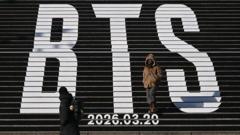
The metallic screech of the AREX train heading into Seoul sounds different this week. Usually, it’s a cold, industrial noise—the soundtrack of a city that lives and breathes by the efficiency of its logistics. But today, the air in the underground platforms feels electric. It’s thick. It’s purple.
Ji-won stands at Exit 9 of Hongdae Station, clutching a laminated map she doesn’t actually need. She is twenty-four, a graphic designer from Busan, and she has saved three months’ worth of salary for this forty-eight-hour window. She isn't here for a shopping spree or a food tour. She is here because a promise made in 2022 is finally being kept.
The world knows them as BTS. To the industry, they are a billion-dollar export, a diplomatic juggernaut, and a case study in digital marketing. To the South Korean government, they were, for eighteen months, soldiers in olive drab. But to the hundreds of thousands of people currently descending upon Seoul, they are the reason a generation learned how to love themselves.
The Silence of the Barracks
When the oldest member, Jin, entered the military gates in late 2022, a strange hush fell over the global music industry. Skeptics whispered that the fever would break. They argued that in the hyper-accelerated world of K-pop, two years of absence is a death sentence. New groups rise every week. Trends evaporate before the ink on the contracts is dry.
They were wrong.
The hiatus didn't create a vacuum; it created a pressure cooker. While the members were learning to fire rifles and navigate frozen trenches near the DMZ, their "Army"—the global fandom—was busy transforming Seoul into a living shrine. This isn't just about a concert. It’s about the return of a cultural heartbeat.
Consider the logistics of a city bracing for a tidal wave. Hotels in the Myeong-dong district have reached 98 percent occupancy. These aren't just rooms; they are temporary galleries. Fans decorate their walls with banners, trade hand-made photo cards in the lobbies, and speak a hybrid language of Korean loanwords and inside jokes.
The Economics of Emotion
If you look at the spreadsheets, the numbers are staggering. Economists estimate that the group’s return and the subsequent festivities could inject upwards of $1.1 billion into the local economy. But spreadsheets are bad at capturing the look on a shopkeeper’s face in Namdaemun Market.
Mr. Park has run a small stationery stall for thirty years. He doesn't know the difference between a "main dancer" and a "sub-vocalist." He does, however, know that when the purple ribbons go up, his sales of notebooks and calligraphy pens triple.
"They brought the world to my door," he says, adjusting a display of purple keychains. "Even when they were away in the army, the girls still came. They walked the streets where the boys used to walk. They ate the spicy rice cakes the boys used to eat. Now that they are coming back? It feels like the holidays, but bigger."
This is the "BTS Effect" in its most granular form. It’s not just stadium tickets. It’s the extra crates of strawberries a farmer in Nonsan has to ship because a member once mentioned loving them. It’s the surge in enrollment for Korean language classes at Yonsei University. It is a soft power so potent it has effectively rebranded an entire nation.
The Invisible Stakes
Why does a pop star’s discharge from military service feel like a national liberation? To understand that, you have to understand the specific weight of the South Korean conscription system.
Every able-bodied man must serve. It is a Great Equalizer, but for a global icon at the peak of his powers, it is also a Great Interrupter. There was a genuine fear—not just among fans, but among cultural critics—that the momentum would vanish. South Korea has spent decades trying to move past its image as a war-torn peninsula defined by its proximity to a hostile neighbor. BTS provided the ultimate "New Korea" narrative: creative, peaceful, and globally dominant.
When they traded their sequins for fatigues, the narrative was put on ice. Their return isn't just a win for the music charts; it is a signal that the machine is back in gear.
A Pilgrimage of the Mundane
The "Army" doesn't just go to the glitzy monuments. They go to the mundane. They visit a small, nondescript building in Gangnam that used to be the group's old practice studio. They sit in a local park because a member once posted a photo of a tree there.
This is a new kind of tourism. It’s a pilgrimage of shared history.
Imagine a girl from Brazil sitting on a bench in Seoul, crying because she’s finally seeing the skyline that she’s only ever seen through a smartphone screen during a 3:00 AM livestream. To her, this city isn't a collection of buildings. It’s the setting of a story that saved her life during the isolation of the pandemic.
The city knows this. The Seoul Metropolitan Government has coordinated with transit authorities to extend subway hours. There are "Purple Zones" designated for fan meetups. Even the N Seoul Tower, the city’s highest point, glows with a violet hue that can be seen for miles.
The Human Core
Behind the brand is a group of young men who are returning to a world that looks very different than the one they left. They are older. They have lived through the grueling, unglamorous reality of military life—a life where they weren't idols, but soldiers identified by numbers.
This transition back to the spotlight is fraught with its own kind of tension. How do you return to being a "God of Pop" after eighteen months of scrubbing floors and night watches?
The fans feel this tension too. There is a protective streak in the Army that you don't see in other fandoms. They don't just want the music; they want to ensure the members are "okay." This creates a symbiotic relationship that defies the typical celebrity-fan dynamic. It’s more like a family reunion where everyone is slightly worried about how much everyone has changed, but relieved to be under the same roof again.
The Night Before the Dawn
Tonight, the Han River is lined with people. Many are camping out, not for a front-row seat at a show, but just to be in the vicinity of the discharge point. They have brought portable heaters and blankets. They share snacks with strangers from countries they’ve never visited.
The conversation is a low hum of anticipation. They talk about the lyrics that got them through breakups, the videos that made them laugh during finals week, and the sheer impossibility of this moment finally arriving.
Seoul isn't just a city tonight. It’s a stadium. It’s a diary. It’s a witness.
As the sun begins to creep over the Lotte World Tower, the air changes. The wait is over. The silence that began in 2022 is being broken, not by a shout, but by a song that millions of people already know by heart.
Ji-won, still standing at the station exit, looks at her watch. She adjusts her backpack and starts walking toward the river. She isn't rushing. She knows they are there. She knows the city is ready.
The world’s biggest band is home, and for the first time in years, Seoul feels like it can finally breathe again.