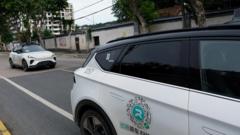
Wuhan just gave the world a reality check. While tech giants promise a frictionless future where cars drive us to work while we nap, the streets of central China recently looked like a scene from a low-budget sci-fi horror movie. A mass robotaxi malfunction turned a busy intersection into a graveyard of stationary metal. No crashes. No blood. Just total, suffocating gridlock caused by machines that forgot how to move.
If you think this is just a glitch in a distant city, you're missing the point. This isn't about one software bug in a Baidu Apollo Go vehicle. It’s about the fundamental brittleness of autonomous systems when they meet the chaotic reality of human environments.
The Day the Sensors Failed Wuhan
The incident happened in the heart of Wuhan, a city that's become the global laboratory for autonomous driving. Baidu’s Apollo Go fleet is everywhere there. Residents usually treat them as a novelty or a cheap way to get around. But on this particular afternoon, several units decided to quit simultaneously at a major junction.
They didn't hit anything. That’s the irony. The safety protocols worked too well. When the "brain" of a robotaxi gets confused by a complex sensor input—maybe a weird reflection, a stray pedestrian, or a slight lag in the 5G handover—it defaults to a "fail-safe" mode. In plain English? It stops dead.
Imagine twenty of these things doing that at once. Humans can't move them. There’s no steering wheel for a helpful bystander to grab. You just have a multi-ton paperweight blocking three lanes of traffic during rush hour.
Why This Keeps Happening and Nobody Wants to Admit It
The industry loves to talk about "edge cases." This is their favorite euphemism for "things our expensive software can't handle yet."
An edge case might be a plastic bag blowing across the road or a cyclist wearing a strangely shaped backpack. To a human, it’s a non-issue. To a LiDAR sensor and a neural network trained on millions of miles of highway, it’s an existential crisis.
The problem in Wuhan wasn't necessarily a hardware failure. It was likely a "fleet-wide" logic error. When one car gets confused by a specific environmental factor, every other car running that same software version might have the exact same meltdown. It’s a systemic vulnerability. Human drivers are unpredictable, but we don't all have a stroke at the exact same second because we saw the same weird shadow.
The Hidden Cost of Cheap Rides
Baidu has been aggressive with pricing in Wuhan. Rides often cost a fraction of what a human Uber or Didi driver charges. People love the savings. But this malfunction highlights the true cost.
- Infrastructure Strain: Cities aren't built for un-movable objects. A broken-down human car can be pushed to the curb. A locked robotaxi is a permanent fixture until a technician arrives with a specialized laptop or a heavy-duty tow truck.
- Economic Disruption: Hundreds of people were late for work, deliveries were delayed, and emergency services had to find workarounds.
- The "Ghost" Problem: Often, these cars stop because they perceive an obstacle that isn't actually there. It’s called a "phantom braking" event. In a dense city, phantom braking is a recipe for a pile-up.
We Are Currently the Lab Rats
Companies like Baidu, Waymo, and Tesla are essentially using public streets as their R&D labs. They'll tell you they've driven billions of simulated miles. Great. But simulations don't account for the messiness of a humid Tuesday in Wuhan or the unpredictable aggression of a delivery scooter.
The data gathered during these failures is incredibly valuable to these companies. They'll fix this specific bug. They'll update the code. But the public is the one paying the price in lost time and safety risks while these multi-billion dollar firms "iterate" on our time.
Don't Buy the Hype Without Checking the Math
There's a narrative that autonomous vehicles are already safer than humans. Statistically, in very specific geofenced areas, that might be true. But safety isn't just about avoiding a collision. It’s about the reliability of the entire transport network.
If a city’s throughput drops by 30% because the "smart" cars are too timid to handle a construction zone, is that a better system? Honestly, no. We're trading human error for machine paralysis.
How to Prepare for the Autonomous Gridlock
If you live in a city where these fleets are expanding—like Phoenix, San Francisco, or Beijing—you need to change how you think about your commute.
Check your local "Autonomous Zones." Most cities have specific areas where these cars are allowed. If your route goes through the center of a test bed, have a backup. A mass stall like the one in Wuhan can turn a 20-minute drive into a two-hour ordeal in seconds.
Pay attention to the weather. Sensors hate heavy rain, thick fog, and even extreme heat. If the conditions are messy, the chance of a robotaxi having a "logic heart attack" goes up exponentially.
Don't assume the car behind you can see you. Even if it’s a "smart" car. The Wuhan event proved that these systems can fail in groups. If you're a cyclist or a pedestrian, give these vehicles a wide berth. They don't have "intuition." They have algorithms, and sometimes those algorithms decide the safest thing to do is just stop, regardless of who is behind them.
The dream of a self-driving utopia is still just that—a dream. For now, we're stuck in the messy, glitchy middle ground. Stay alert, keep your hands on the wheel if you're driving, and don't trust the machines more than they trust themselves. They know they're prone to failure; that's why they stop. You should be just as cautious.