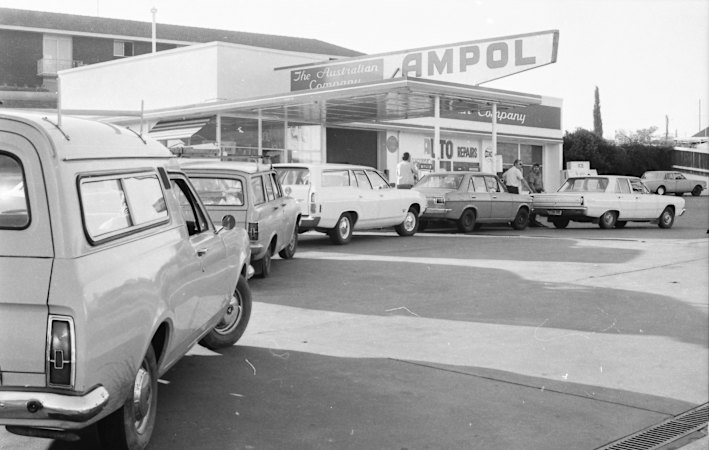
The metal nozzle felt unnervingly cold against Elias’s palm as he squeezed the trigger for the third time. Nothing. Not even a vaporous hiss. Behind him, a line of sedans and pickup trucks stretched nearly a mile into the bruised purple of the Virginia twilight, their idling engines sounding like a collective, rhythmic prayer for a resource that simply wasn't there.
Elias wasn't a historian. He was a shift manager at a logistics hub who just wanted to get home. But as he looked at the "Out of Service" bag taped over the pump, he was inadvertently living through a ghost story—a haunting recurrence of the 1970s that everyone in Washington had promised could never happen again.
The crisis didn't start at the pump. It started in the quiet, climate-controlled offices of the West Wing and the Pentagon, where the hard-learned lessons of the past were treated like optional suggestions rather than survival blueprints. When the Trump administration and its defense leadership looked at the global energy grid, they saw a trophy. They didn't see a tether.
The Myth of the Island
There is a seductive lie that powerful nations tell themselves: we are an island. We are told that because we sit on vast reserves of shale and gas, the tremors of the outside world cannot shake our foundations. It is a comforting thought. It is also a dangerous one.
During his tenure, Donald Trump championed a doctrine of "energy dominance." On the surface, the math looked impeccable. Production was up. Exports were booming. But dominance is not the same thing as resilience. By pivoting away from international energy alliances and treating global stability as a nuisance rather than a necessity, the administration pulled the threads out of a safety net that had been woven over decades.
Consider the role of the Secretary of War—now the Secretary of Defense. Historically, this role understood that fuel is the literal blood of the military and the economy. If the arteries are blocked overseas, the heart at home begins to fail, regardless of how much oil is sitting in a Permian Basin wellhead thousands of miles away. By ignoring the fragile logistics of the global supply chain, the leadership essentially left the front door open while bragging about the strength of the walls.
The Ghost of 1973
To understand the weight of this failure, we have to look at a man named Arthur. In 1973, Arthur sat in a similar queue, sweating in a Buick with no air conditioning, watching the price of a gallon jump while the geopolitics of the Middle East shifted under his feet.
The lesson Arthur’s generation learned was brutal: energy is a weapon of diplomacy. When the Nixon administration found itself blindsided by the OPEC embargo, it wasn't just a failure of production; it was a failure of foresight. The U.S. realized it could not bully its way out of a shortage if it hadn't secured the routes and relationships required to move that energy.
Fast forward to the recent past. The Trump administration’s approach was a mirror image of that old arrogance. By withdrawing from international agreements and alienating traditional energy partners, they bet everything on the idea that the U.S. could go it alone. They ignored the reality that oil is a fungible global commodity. If a tanker is seized in the Strait of Hormuz or a pipeline is hacked in Eastern Europe, the price at a suburban gas station in Ohio spikes instantly.
You cannot drill your way out of a systemic collapse.
The Secretary and the Blind Spot
The defense leadership during this era seemed more preoccupied with the optics of strength than the mechanics of stability. While the Pentagon should have been the loudest voice in the room warning about the vulnerability of our energy infrastructure, it often played the role of the silent enabler.
They focused on hardware. More planes. Faster ships. Larger tanks. But a tank without a steady, uninterrupted flow of fuel is just a very expensive paperweight. By failing to integrate energy security into the core of their strategic planning—and by dismissing the accelerating risks of climate-driven resource scarcity—the "Secretary of War" and the President ignored the very logistics that won World War II.
Efficiency was traded for bravado. Long-term stability was sacrificed for short-term stock bumps.
The Human Cost of Arrogance
Back at the gas station, the reality isn't about policy papers or cabinet meetings. It’s about the nurse who can’t make it to her twelve-hour shift because her tank is on E. It’s about the grocery store shelves that sit empty because the trucking fleet is grounded by rationing.
Rationing is a word that sounds like it belongs in a black-and-white newsreel. It feels like something that happens "somewhere else." But when leadership ignores history, "somewhere else" arrives at your doorstep with terrifying speed.
We saw the cracks forming early. When the Colonial Pipeline was hit by a cyberattack, the panic wasn't just about a computer virus; it was a visceral reaction to the realization that our system is held together by digital string and hopeful thinking. The administration’s response to such vulnerabilities was often more about finding someone to blame than fixing the structural rot.
The Invisible Stakes
Why does this matter now? Because history isn't a straight line. It’s a circle.
The decisions made to ignore international energy cooperation and prioritize isolationist rhetoric have left the current infrastructure more brittle than ever. We are living in the aftershocks of a period where the "lessons of history" were viewed as dusty relics rather than active warnings.
The true cost of ignoring these lessons isn't measured in dollars. It’s measured in the loss of agency. When a nation loses control over its energy narrative, it loses the ability to protect its most vulnerable citizens. The queues aren't just lines of cars; they are lines of people whose lives have been put on hold by the ego of men who thought they were bigger than the market.
Elias eventually gave up. He turned off his engine and sat in the silence of his cabin, watching the blue light of his phone as he scrolled through news reports of "unprecedented" shortages.
The irony, of course, was that they weren't unprecedented at all.
They were predicted. They were documented. They were avoidable.
As the sky turned to a deep, hollow black, the only thing moving in the long line of cars was the occasional flicker of a cigarette or the glow of a dashboard. A caravan of the stranded, waiting for a tomorrow that the past had already warned them would be dark.
The engine clicked as it cooled, a small, metallic sound in the vast quiet of a country that had forgotten how to listen to its own history.