The Pixels That Ate the Moon
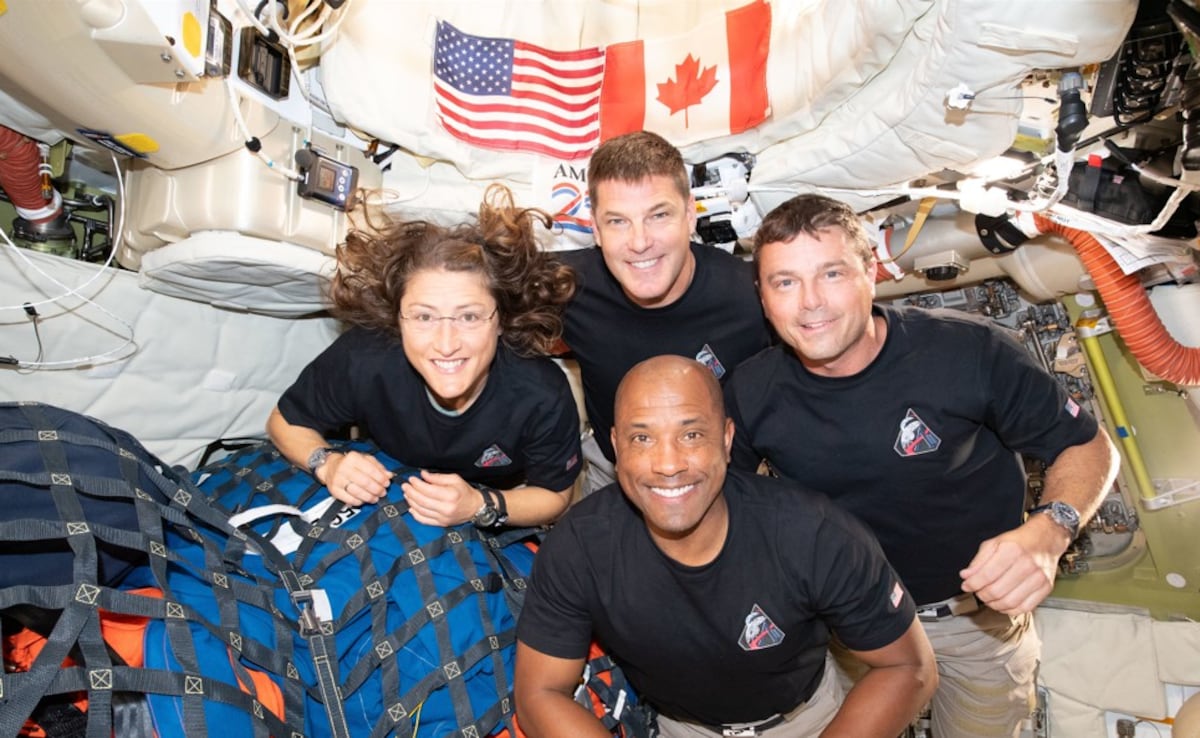
In a darkened living room in suburban Ohio, a man named Elias stares at a high-resolution photograph of four astronauts. They are the crew of Artemis II—the first humans to venture toward the Moon in over half a century. Reid Wiseman, Victor Glover, Christina Koch, and Jeremy Hansen stand in their sleek, dark-blue flight suits, grinning with the practiced confidence of people who have stared death in the face and won.
Elias should feel a prickle of pride. He should feel that ancient, tribal stir of "we are going back." Instead, he pinches his fingers on his smartphone screen, zooming in until the image breaks into a jagged mosaic of color. He is looking for a glitch. He is looking for a sixth finger, a blurring of the NASA logo, or a reflection in a helmet visor that doesn't quite obey the laws of physics.
"Fake," he mutters, his thumb hovering over the share button.
He isn't alone. Within minutes of NASA releasing the official portraits and promotional footage for the Artemis II mission, the digital town square ignited. The accusations didn't come from the fringes of the old-school "Moon landing was filmed in a desert" crowd. These were new skeptics. They weren't citing grainy 1969 film reels; they were citing the uncanny valley of 2024 generative AI.
The tragedy isn't that NASA is lying. The tragedy is that we have reached a point where the truth looks exactly like a lie.
The Cost of Perfection
The problem started with a studio light. To the untrained eye, the Artemis II promotional materials look too good. The lighting is cinematic. The shadows are soft, hitting the astronauts’ faces with a precision that suggests a high-end Hollywood production rather than a government hangar.
In the age of Midjourney and DALL-E, perfection is the primary red flag. When an image is balanced, vibrant, and flawlessly composed, our modern brains—rewired by a decade of deepfakes—immediately trigger a defense mechanism. We have been lied to so often by our screens that we now view clarity as a form of deception.
Consider the technical reality: NASA shot these photos in a controlled studio environment. Professional photographers used three-point lighting systems. They used high-end digital sensors that capture a dynamic range the human eye can barely process. But to a public fed on a daily diet of AI-generated "art," that professional sheen feels artificial.
The irony is thick enough to choke on. For decades, the space agency fought to make space travel look accessible and beautiful. Now that they have the technology to show us the Moon in 8K, we don't believe the camera exists. We have traded our sense of wonder for a magnifying glass, searching for the "tell" that proves the whole thing was rendered on a server farm in Northern Virginia.
A Ghost in the Reflection
The skeptics pointed to specific "anomalies." They noted the way the light reflected off the visors, claiming the curves didn't match the studio lights. They dissected the texture of the fabric on the suits, calling it "too smooth," a classic hallmark of AI-generated textures.
But these "glitches" are often just the result of how modern digital cameras process light. When a high-resolution sensor captures a metallic or plastic surface, it often applies internal sharpening and noise reduction. This "computational photography"—the same stuff that makes your iPhone photos look good—actually strips away the "grit" we associate with reality.
We are living through a strange inversion of history. In 1969, the "evidence" for the hoax was the lack of stars in the sky or the "waving" flag. Those were misunderstandings of vacuum physics. Today, the "evidence" is a lack of digital noise. We want the images to be worse. We want them to look messy, because messiness is the only thing we still trust.
Hypothetically, let’s look at a digital artist named Sarah. She spends ten hours a day prompting AI to create landscapes. She knows that AI struggles with hands, text, and specific types of symmetry. When she looks at the Artemis II crew photo, she sees the very things she spends her day correcting. She sees "perfect" skin tones and "perfect" lighting. Her professional intuition, honed by the artificial, betrays her when she looks at the authentic. She sees a ghost where there is only a human in a suit.
The Invisible Stakes of Disbelief
This isn't just about a few internet comments. The stakes are grounded in the very survival of the mission. Space exploration requires more than just liquid oxygen and brave pilots; it requires a mandate. It requires a collective belief that the endeavor is real and worth the staggering cost.
When a significant portion of the population believes the promotional materials are "generated," the mission loses its soul. It becomes a movie. And if it's a movie, why should we fund it? Why should we care if they "land" on the Moon if the footage is indistinguishable from a video game trailer?
NASA is currently fighting a war on two fronts. One is the physical vacuum of space, where they must navigate the Orion spacecraft through the Van Allen radiation belts. The other is the psychological vacuum of the internet, where facts are sucked out and replaced by the loudest theory.
The agency’s response has been one of quiet transparency. They released behind-the-scenes footage of the photo shoots. They showed the lights. They showed the photographers. They showed the sweat on the astronauts' brows. But in the digital age, even "behind-the-scenes" footage can be faked. It is a recursive loop of doubt. Once the seal of trust is broken, no amount of evidence can reseal it.
The Human Element in a Synthetic Era
Why do we want it to be fake?
Perhaps it’s a coping mechanism. The idea of four humans strapped to a controlled explosion, hurtling toward a gray rock 238,000 miles away, is terrifying. It is an act of extreme vulnerability. If it’s just AI—if it’s just pixels and code—then no one is in danger. We don't have to hold our breath. We don't have to worry about the heat shield or the life support systems.
But if we surrender to that cynicism, we lose the most important part of the story: the courage.
Victor Glover isn't a collection of polygons. He is a father and a pilot who has spent thousands of hours training for the moment the vibration of the SLS rocket rattles his teeth. Christina Koch isn't a prompt. She is a scientist who spent 328 days in orbit, seeing the sun rise and set sixteen times a day.
When we call these images "AI-generated," we are effectively erasing their humanity. We are saying that their bodies, their risks, and their years of sacrifice are no longer necessary in our world of easy simulations. We are choosing the comfort of a conspiracy over the terrifying beauty of a real achievement.
The Texture of Truth
To find the truth, we have to look for the things AI still can't capture. Not the fingers or the logos, but the specific, heavy weight of human history.
Look at the eyes of the Artemis crew. AI can generate a "determined gaze," but it cannot yet replicate the specific, weary depth of a person who has spent a decade preparing for a single moment. There is a micro-tension in the muscles of the neck, a subtle asymmetry in the way a real human body holds itself under the weight of a pressurized suit.
The Artemis II mission is a bridge. It is a bridge between the analog glory of the Apollo era and a future where the line between real and digital will vanish entirely. We are the last generation that will remember what it feels like to know, for a certainty, what is real.
The "internet" may call the mission fake, but the internet is a machine. It processes data; it doesn't process experience. It can analyze the frequency of light in a photograph, but it cannot feel the ground shake at the Kennedy Space Center.
The Long Road to the Far Side
In the coming months, the noise will only get louder. When the Orion capsule swings around the far side of the Moon, and the first "live" images of the lunar surface beam back to Earth, the skeptics will be ready. They will look for frame-rate inconsistencies. They will look for "tells" in the lunar dust.
They will be looking so hard for the lie that they will miss the moonrise.
The real danger isn't that someone will trick us with a fake moon landing. The real danger is that we will be presented with the most magnificent achievement of our century and we will choose to look away because we’ve forgotten how to believe in anything we can’t touch.
Elias, back in Ohio, finally puts his phone down. He hasn't found the sixth finger. He hasn't found the glitch. He feels a strange, uncomfortable sensation in his chest—a mixture of doubt and a tiny, flickering hope. He remembers being a child, looking through a telescope at a blurry, white disc. It didn't look "cinematic" then. It looked cold and distant and impossibly real.
We are going back. Not because the images are perfect, but because the humans inside the suits are flawed, brave, and undeniably there. The pixels are just the messenger. The message is the fire, the vacuum, and the four hearts beating inside a metal shell, pushing against the dark.
The Moon doesn't care if we believe in it. It remains there, silent and scarred, waiting for the first footprints of a new age. We can stay in the darkened room, zooming in on the shadows, or we can step outside and look up.
One is a simulation. The other is a soul.