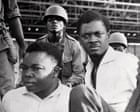
Belgium is finally staring into the abyss of its own colonial shadow. A court in Brussels has ordered a 93-year-old former diplomat to stand trial for his alleged role in the 1961 assassination of Patrice Lumumba, the Democratic Republic of the Congo’s first democratically elected prime minister. This isn't just a late-stage legal maneuver. It is a desperate, final attempt to extract a confession from a generation that is rapidly disappearing into the grave, taking the secrets of a Cold War execution with them.
The defendant, identified under Belgian privacy laws as Pierre G., was a young diplomat stationed in the Katanga region during the chaotic months following Congolese independence. Prosecutors allege he was part of the machinery that handed Lumumba over to his executioners. This trial represents more than a criminal proceeding against a nonagenarian. It is a reckoning for a nation that has spent sixty years treating the murder of a foreign head of state as an unfortunate administrative oversight rather than a state-sponsored hit.
The Architecture of a Cold War Execution
To understand why this trial matters now, you have to look past the modern courtroom and into the humid, terrifying reality of January 1961. Patrice Lumumba was a problem for the West. He was charismatic, uncompromising, and refused to let Belgian mining interests dictate the terms of Congolese sovereignty. In the eyes of Brussels and Washington, he was a potential Soviet bridgehead in Africa.
The execution was not a spontaneous act of local violence. It was a calculated, multi-layered operation. Lumumba was beaten, flown to the secessionist region of Katanga, and shot alongside two associates. The physical act was carried out by Congolese soldiers, but the room was filled with Belgian officers. The logistics were handled by Belgian advisors. The cover-up was managed by the Belgian government.
The core of the prosecution’s case rests on the "transfer" of Lumumba. Under international law, handing a prisoner over to a group you know will kill them is not a passive act. It is complicity. Pierre G. is accused of being a crucial link in that chain. For decades, the defense of men like him has been built on the "fog of war" and the claim that they were merely observers. This trial seeks to prove they were the architects.
The Teeth of the Commission
In 2001, a Belgian parliamentary commission admitted that the country bore "moral responsibility" for the murder. That was a polite way of saying they knew it happened and helped it along but didn't want to go to jail for it. The commission's findings led to an official apology from the Belgian government in 2002. For many, an apology was the end of the story. For the Lumumba family and human rights lawyers, it was only the beginning of a legal paper trail.
The legal hurdle has always been the statute of limitations. How do you prosecute a murder from 1961 in the 2020s? The answer lies in the classification of the act as a war crime. War crimes do not expire. By framing the assassination within the context of the armed conflict in Katanga, prosecutors have bypassed the usual expiration dates on justice.
This is a high-stakes gamble. If the court finds that the assassination was a common crime rather than a war crime, the case collapses. If they uphold the war crime designation, it sets a precedent that could haunt other former colonial officials still living in quiet Belgian suburbs.
The Missing Pieces of the Puzzle
The physical evidence in this case is hauntingly sparse. We know that Lumumba’s body was dissolved in sulfuric acid by a Belgian police officer, Gerard Soete, to ensure there was no grave for his supporters to visit. Soete kept two of Lumumba’s teeth as macabre trophies. One of those teeth was seized from Soete's daughter by Belgian authorities years later and finally returned to the Congo in 2022.
The return of the tooth was a massive symbolic victory, but symbols don't win court cases. Documents do. The prosecution has spent years digging through archives that were never intended to see the light of day. They are looking for the "smoking gun" telegrams and orders that prove Pierre G. knew exactly what would happen when Lumumba touched down on that Katangan airstrip.
Critics of the trial argue that it is a "show trial" targeting a man who is too old to defend himself effectively. They claim that focusing on one 93-year-old man ignores the systemic nature of the crime. There is some truth to this. Pierre G. was a cog in a much larger machine that included the CIA and the upper echelons of the Belgian monarchy. However, in the eyes of the law, the machine is made of individuals. Every cog is responsible for the direction the wheels turn.
The Geopolitical Stakes for Modern Belgium
Belgium is currently trying to redefine its relationship with its former colonies. It wants to be seen as a modern, progressive European partner. But you cannot build a new relationship on a foundation of unprosecuted murders. The DR Congo remains one of the most resource-rich yet unstable nations on earth, a direct consequence of the vacuum left by Lumumba’s death and the subsequent decades of the Mobutu dictatorship—a regime Belgium helped install.
For the Congolese diaspora, this trial is about validation. For years, their version of history was dismissed as conspiracy theory. Now, a Belgian judge has looked at the evidence and decided it is enough to warrant a trial. That alone is a seismic shift in the power dynamic between the colonizer and the colonized.
The Strategy of Delay
The defense will almost certainly use the defendant’s age and health as a primary shield. This is a common tactic in late-stage war crimes trials. By dragging out procedural motions, they hope to outlast the court's clock. If the defendant dies before a verdict, the case is closed, and the truth remains officially "undetermined."
This puts immense pressure on the Brussels judiciary to move with a speed they are not known for. They are balancing the rights of a defendant with the right of a nation to see justice served before the last witnesses fade away.
The investigation has uncovered that the decision to eliminate Lumumba was discussed at the highest levels of the Belgian government. This wasn't a rogue operation. It was policy. The trial of Pierre G. is, by extension, a trial of the Belgian state's 1961 policy framework. It asks whether "national interest" is a valid defense for the extrajudicial killing of a foreign leader.
The Burden of Proof in an Erased History
We are dealing with a crime where the evidence was intentionally destroyed. The acid, the fire, the shredded documents—these were all part of the original plan. The prosecution has to rebuild a three-dimensional crime from two-dimensional fragments. They are relying on circumstantial evidence that, when viewed in its entirety, points to a coordinated conspiracy.
- Logistical support: Belgian planes and pilots were used for the transport.
- Command structure: Belgian officers were present during the beatings and the execution.
- Diplomatic cover: The Belgian diplomatic corps provided the necessary political shielding to prevent international intervention.
Pierre G. sits at the intersection of these three points. As a diplomat on the ground, his role was to ensure the "transfer" went smoothly without creating an international incident. He succeeded in 1961. The question is whether that success will finally be rebranded as a felony in 2026.
Beyond the Verdict
Regardless of whether Pierre G. is convicted, the process has already achieved something remarkable. It has forced the opening of archives and the recording of testimonies that would otherwise have been lost. It has moved the conversation from "moral responsibility" to "criminal liability."
This case serves as a warning to those currently serving in diplomatic and military roles. It suggests that the protection of the state is not eternal. The "just following orders" defense has been failing since Nuremberg, but this trial applies that failure to the colonial context in a way we haven't seen before.
The trial is a grim reminder that history is never really over. It is a living, breathing entity that can wait sixty years to demand an accounting. The Brussels court is not just judging a man; it is judging a century of exploitation.
Check the court records for the next hearing date and monitor whether the defense files for a stay based on medical incapacity. That will be the first indicator of whether this trial will reach a conclusion or end in a quiet hospital room.