The air in the Strait of Hormuz doesn't just feel hot. It feels heavy, like a wet wool blanket soaked in salt and diesel fumes. At its narrowest point, the waterway is only twenty-one miles wide. That is not a lot of room when you are maneuvering a hundred thousand tons of nuclear-powered American diplomacy.
On the bridge of a U.S. destroyer, the silence is tactical. It is a quiet composed of humming electronics, the rhythmic pulse of radar, and the steady breathing of young men and women who are acutely aware that they are sailing through one of the most volatile choke points on Earth. They are watching the green glow of screens. They are waiting for the radio to crackle.
Then, the swarm appears.
The Art of the Near-Miss
The Iranian Revolutionary Guard Corps (IRGC) does not use a traditional navy in the way the West understands it. They don't rely on massive cruisers or sweeping carrier groups. Instead, they favor the "mosquito" strategy—fast, agile, highly armed speedboats that can weave through the waves like hornets.
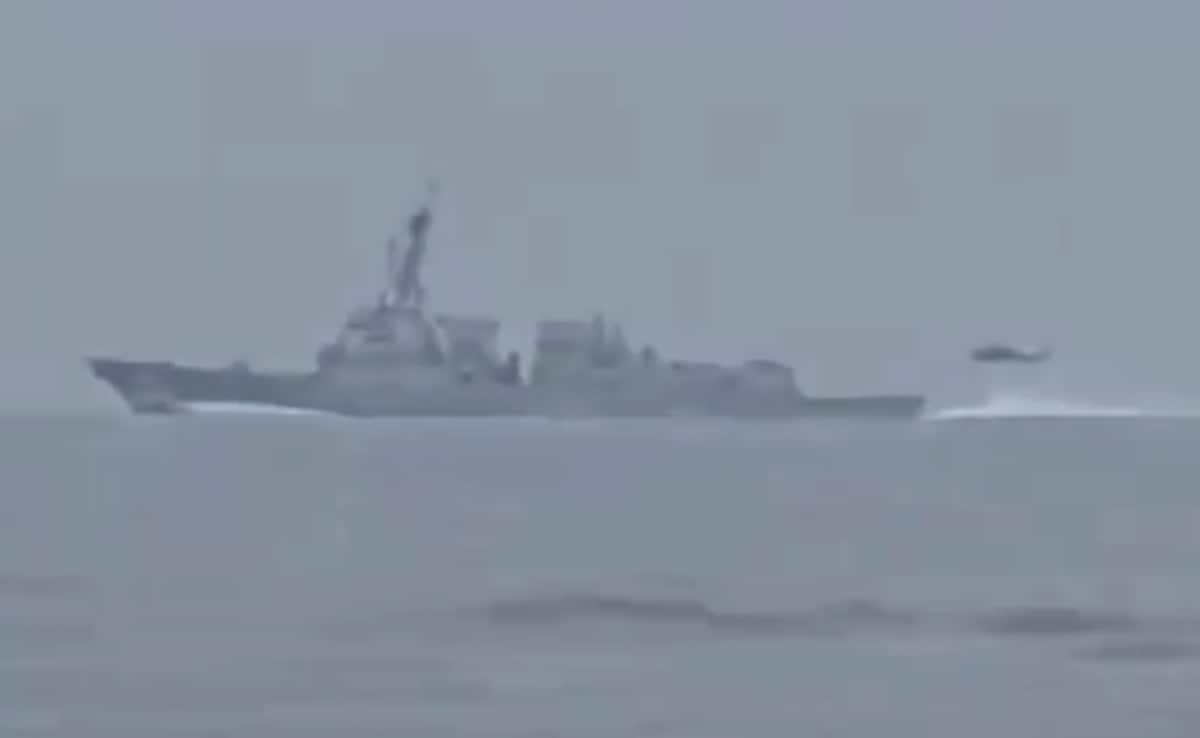
A video recently surfaced, released by Iranian state media, capturing a confrontation that has become a hauntingly common ritual in these waters. In the footage, the camera shakes with the vibration of a high-speed engine. You see the wake of an Iranian patrol boat cutting sharply toward the hulking gray silhouette of a U.S. warship.
The voice on the radio is sharp. It is a warning. It is a claim of ownership over a patch of blue that the rest of the world considers an international highway.
To an outsider, this looks like a skirmish. To the sailors on those decks, it is a high-stakes game of chicken where the price of a single miscalculation is measured in lives and global economic shockwaves. If a nineteen-year-old gunner on a deck in the Persian Gulf flinches, the price of gasoline in Ohio or Tokyo could spike by morning.
The Invisible Chokehold
Why does a strip of water barely wider than the distance of a marathon matter so much?
The Strait of Hormuz is the world's jugular vein. Approximately one-fifth of the world’s total oil consumption passes through this needle's eye every single day. If you closed it, the global economy wouldn’t just slow down; it would seize.
The Iranian government understands this leverage perfectly. The videos they release are rarely about actual combat. They are about the threat of combat. They are cinematic tools designed to project power to a domestic audience and to signal to the West that while the U.S. may have the bigger hammers, Iran holds the keys to the garage door.
Consider the perspective of a hypothetical Iranian commander on one of those speedboats. Let’s call him Reza. For Reza, harassing a massive American vessel isn't an act of madness; it’s an act of asymmetric defiance. He knows he cannot win a head-to-head war against a carrier strike group. But he also knows that he doesn't have to win. He only has to make the Americans uncomfortable. He only has to prove that the "Great Satan" can be poked, prodded, and filmed while doing so.
A Language of Gray Zones
This is what military analysts call "Gray Zone" warfare. It is the space between peace and all-out conflict. In the gray zone, you don't fire missiles; you fire signals. You sail too close. You point a laser. You broadcast a threat.
The U.S. Navy operates under strict Rules of Engagement (ROE). These are the invisible lines in the sand that dictate when a sailor can pull a trigger. These rules are designed to prevent an accidental World War III. The IRGC knows these rules as well as the Americans do. They dance right on the edge of them, pushing the envelope to see exactly how much friction the U.S. is willing to tolerate before it pushes back.
The tension is psychological. Imagine standing on a pier and having someone walk up and stand two inches from your face. They haven't hit you. They haven't even touched you. But they are breathing your air, and they are watching your eyes for the slightest hint of fear or aggression. That is the Strait of Hormuz on any given Tuesday.
The Human Cost of Constant Vigilance
Behind the geopolitical posturing and the grainy video footage are the people who actually have to live through the "Last Warning."
For the American sailor, the stress isn't the fight; it’s the possibility of the fight. It is the six-month deployment where every afternoon brings another shadow on the horizon. It is the "General Quarters" alarm that wakes you from a deep sleep, forcing you to sprint to your station in the dark, wondering if this time the radar contact is a fishing boat or a suicide drone.
For the Iranian sailor, it is the reality of being a small piece in a much larger political machine. They are operating in vessels that would be obliterated in minutes if a real conflict broke out. They are the sacrificial pawns on a chessboard where the kings are sitting in air-conditioned offices in Tehran and Washington D.C.
The release of these videos serves a specific emotional purpose. They are meant to feel like a climax, a "last warning" as the title suggests. But in reality, they are a loop. This standoff has been happening, in various forms, since the late 1970s. The actors change, the cameras get better, but the script remains remarkably the same.
The Logic of the Brink
There is a terrifying logic to this brinkmanship. Both sides are communicating in a language where words have lost their meaning, so they use steel instead.
When Iran releases a video of their boats surrounding a U.S. ship, they are telling their people: We are not afraid.
When the U.S. Navy continues its "Freedom of Navigation" operations, they are telling the world: The lanes stay open.
The danger lies in the "Tactical Level Misunderstanding." This is the military term for a mistake. A steering failure on a speedboat. A radio transmission that gets garbled. A nervous finger on a weapon system. In the cramped, humid confines of the Strait, there is no such thing as a small error.
We often talk about these events as if they are abstract news items, something to be read and forgotten. But the Strait of Hormuz is a pressure cooker with no relief valve. Every time a video like this is released, the pressure ticks up just a little bit higher.
The world watches the grainy footage of speedboats buzzing around a titan of the seas. We see the spray of the water and hear the distorted voices over the radio. We focus on the ships. We should be focusing on the hands on the throttles and the eyes behind the binoculars.
Those hands are steady for now. But the salt is abrasive, the heat is relentless, and the chessboard is getting smaller every year.
The ships continue their slow, heavy dance through the turquoise water. The speedboats circle like sharks. The cameras record it all for the next news cycle. And underneath it all, the silent, heavy weight of the world's economy hangs by a single, frayed thread of restraint.