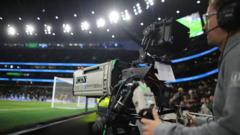
The modern football fan is no longer a spectator. They are a prop. When the red "On Air" light flickers to life in a production truck parked outside a Premier League stadium, the thousands of supporters shivering in the stands cease to be the lifeblood of the sport and become mere background texture for a global broadcast product. Sky Sports and its rival broadcasters are currently locked in a cycle of scheduling that prioritizes armchair viewers in Singapore and New York over the season-ticket holder from Sheffield or Southampton. This isn't a "headache." It is a calculated strip-mining of the match-going experience to satisfy the insatiable demands of a multi-billion pound domestic rights deal.
The tension between those who pay for a seat and those who pay for a subscription has reached a breaking point. For decades, the 3:00 PM Saturday kickoff was the sacred heart of the English game. Today, it is a hollowed-out shell, with the most attractive fixtures routinely uprooted and replanted into slots that make travel physically or financially impossible for the away contingent.
The Cold Logic of the TV Calendar
Broadcasters do not move games to be cruel. They move them because the data tells them to. When Sky Sports selects a match for the Sunday 4:30 PM slot or the increasingly frequent Monday night window, they are maximizing "reach" and "engagement" metrics that drive advertising revenue. To a broadcast executive, a 500-mile round trip for a Newcastle fan on a Tuesday evening is an invisible externality. It does not show up on a balance sheet.
What does show up is the viewing figure. The Premier League’s current domestic TV rights deal is worth roughly £6.7 billion. When you deal in those figures, the logistical nightmare of a fan trying to catch the last train home becomes a rounding error. The "picks" are determined by a complex interplay of club popularity, divisional standings, and the "protection" of certain broadcast windows.
The mechanism is simple. Sky and TNT Sports (formerly BT) get first dibs on the "Grade A" fixtures. They want the big hitters—Liverpool, Manchester United, Arsenal—in the slots that capture the largest global audience. The fallout is a schedule that remains fluid until just weeks before kickoff, leaving fans to gamble on non-refundable train tickets and hotel rooms. This is the hidden tax on loyalty.
The Death of the Last Train Home
Consider the logistical reality of a Monday night fixture between two teams at opposite ends of the country. A 8:00 PM kickoff means the final whistle blows around 9:55 PM. By the time away fans are ushered out of the stadium and navigate local transport, it is well past 10:30 PM. In the UK’s aging and fragmented rail network, the last service heading toward a distant home city has often already departed.
This forces a choice. The fan can either pay for an overnight stay—adding £100 or more to an already expensive day—or they can embark on a grueling multi-hour drive through the night. It is a war of attrition. Young families are being priced and timed out of the away-day tradition, replaced by a demographic that can afford the luxury of spontaneity.
The broadcasters argue that without their investment, the Premier League could not afford the world-class talent that fans want to see. This is the great irony of modern football. The money that buys the superstars is the same money that prevents the most dedicated fans from seeing them in the flesh. It is a symbiotic relationship that has turned parasitic.
The Illusion of Consultation
Periodically, the Premier League or the broadcasters will release a statement affirming their commitment to "consulting with fan groups." These meetings are largely performative. While there are guidelines regarding how much notice should be given for a fixture change—usually six weeks—these deadlines are frequently missed or ignored during the busy festive period or the business end of the season.
The Football Supporters’ Association (FSA) has campaigned for years to have travel logistics baked into the selection process. They have proposed a "common sense" filter. If a game involves a travel distance of more than 150 miles, it should not be allowed to kick off after a certain time on a weekday or Sunday. The response from the boardrooms is usually a polite nod followed by a return to business as usual.
Broadcasters know they hold the cards. If a club complains too loudly about the treatment of its fans, they risk biting the hand that feeds them the television revenue required to stay competitive. It is a classic Mexican standoff where the fan is the only one without a gun.
Why the European Model Fails Here
Critics often point to Germany’s Bundesliga as the gold standard for fan treatment. There, the "50+1" rule ensures fans retain a majority of voting rights in their clubs, leading to cheaper tickets and a fierce protection of the Saturday afternoon kickoff. However, the English model is built on a different foundation. The Premier League is a commercial juggernaut first and a sporting competition second.
The revenue gap between the Premier League and its European rivals is largely due to this aggressive broadcasting strategy. We have traded soul for silverware. By carving the weekend into seven or eight different viewing windows, the league has maximized the product's surface area for advertisers. You cannot have the world's most expensive league and the world's most fan-friendly schedule simultaneously. They are ideologically opposed.
The Rise of the Armchair Consumer
We are witnessing a fundamental shift in who the "primary customer" is. Twenty years ago, the primary customer was the person in the stadium. Today, the primary customer is the person with the streaming app. This shift has psychological consequences. When a stadium looks empty because away fans couldn't make a late-night kickoff, it hurts the "brand" of the Premier League.
Sky Sports goes to great lengths to hide these gaps. Camera angles are tight. Artificial crowd noise is occasionally layered into the mix. The goal is to present a vibrant, high-energy product to the world, even if the reality on the ground is one of exhaustion and resentment.
The cost of a single away trip can now exceed £200 when factoring in travel, tickets, and food. For a working-class supporter, this is no longer a hobby; it is a significant financial burden. When you add the disrespect of a three-week notice period for a 200-mile trip, you aren't just making it difficult for fans to attend. You are telling them they aren't wanted.
The Breaking Point of the Product
There is a risk that the broadcasters are overplaying their hand. The unique selling point of English football has always been the atmosphere. The roar of the crowd, the back-and-forth between home and away sections—this is what makes a drab 0-0 draw in the rain watchable for a viewer in Beijing. If you continue to squeeze the away fans out, you lose that atmosphere.
If the stadium becomes a quiet theater of corporate guests and day-trippers, the TV product will eventually suffer. The "headache" Sky is causing isn't just a logistical problem for fans. It is a slow-burning crisis for the sport's long-term cultural health. You can only ignore the people who provide your background noise for so long before they stop showing up to make it.
The solution requires more than just longer notice periods. It requires a hard cap on the number of long-distance games that can be moved to antisocial hours. It requires broadcasters to contribute to a travel fund for fans affected by late changes. Most importantly, it requires a shift in mindset. A football match is a community event that happens to be televised, not a television show that happens to have a live audience.
Demand that your club representatives bring the "Traveler’s Charter" back to the table at the next shareholders' meeting. Until the fans' time is valued as highly as the broadcaster's airtime, the migration from the terraces to the sofa will only accelerate. The game is being sold off piece by piece, and the away end is the first thing to go.