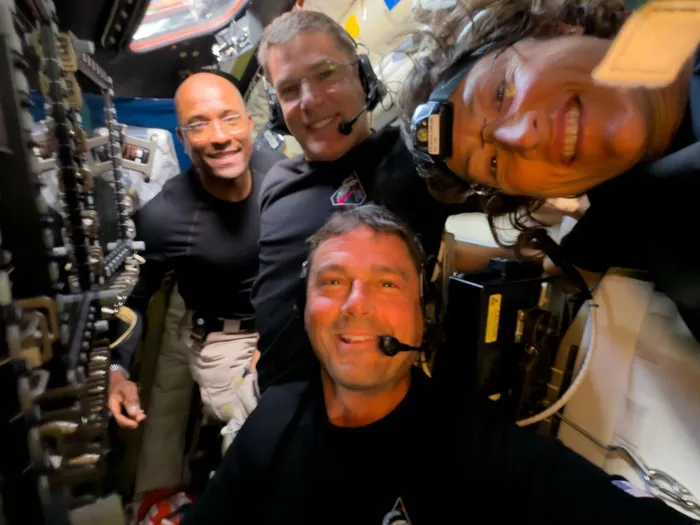
The headlines are screaming about a record-breaking triumph. They want you to believe that the Artemis II crew just pulled off a feat of celestial acrobatics by swinging around the lunar far side during a solar eclipse. The narrative is thick with "daring" maneuvers and "historic" milestones.
It is a lie of omission. If you liked this piece, you might want to check out: this related article.
Artemis II is not a bold leap into the unknown. It is a highly choreographed, risk-averse physics demonstration that costs more than any single mission should ever cost in the 21st century. Calling a free-return trajectory "daring" is like calling a train ride "an adventurous trek" because the tracks happen to go over a mountain. The orbital mechanics were settled in the 1960s. The "record" being broken is a technicality of trajectory, not a breakthrough in capability.
The Free Return Trajectory is a Safety Net Not a Sword
The media is obsessed with the distance record. Artemis II will travel further from Earth than any human in history. But distance is a vanity metric. For another perspective on this story, see the recent update from Engadget.
The mission uses a Free-Return Trajectory. For the uninitiated, this means that once the Orion spacecraft is kicked into its trans-lunar injection, Earth’s gravity and lunar gravity do 99% of the work. If the engines fail the moment they leave Earth’s orbit, the ship simply loops around the moon and falls back to Earth.
It is the celestial equivalent of a bowling ball in a gutter with bumpers.
- The Competitor View: A dangerous, high-stakes flyby.
- The Reality: The most conservative flight path possible for a crewed lunar mission.
We are celebrating a mission designed specifically so that the astronauts don't have to do anything "daring" if things go wrong. While safety is vital, marketing this as a gritty frontier conquest is intellectually dishonest. We aren't conquering the moon yet; we are dipping a toe in the water while wearing a life jacket, water wings, and holding onto a literal rope tied to the shore.
The Solar Eclipse Distraction
The mention of the solar eclipse during the flyby is the ultimate PR shiny object. It makes for great photos. It provides a "unique scientific opportunity."
In reality, it’s a thermal management headache that the engineers had to account for, not a feature of the mission. Eclipses happen. Space is big, but orbital planes intersect. Aligning a crewed mission with a solar eclipse adds layers of complexity to power budgets—specifically battery discharge rates when the solar panels go dark—without adding a single gram of utility to the goal of putting boots on the ground.
If you want to study an eclipse, send a $50 million CubeSat. Don't risk a multi-billion dollar crewed asset and then pretend the timing was a stroke of genius. It was a constraint, not a goal.
The SLS Elephant in the Room
We need to talk about the Space Launch System (SLS). I have watched NASA programs iterate for decades, and SLS is the pinnacle of "sunk cost" engineering.
Every time an SLS rocket clears the tower, $2 billion vanishes. That isn't the development cost; that is the marginal cost per launch. For the price of one Artemis II mission, the private sector could have launched a fleet of autonomous refuelling depots and reusable landers.
The "status quo" insists that we need this heavy-lift capability to reach the Moon. They are wrong. We don't need a bigger hammer; we need a more efficient way to build the house.
- Orion is overweight. The service module, provided by ESA, is a marvel, but the capsule itself is so heavy that the SLS—the most powerful rocket ever built—can barely get it to a High Earth Orbit before the final push.
- Lack of Reusability. In an era where SpaceX recovers boosters on floating platforms, NASA is still dropping multi-billion dollar engines into the Atlantic. It is 1970s logic wrapped in a 2026 tax bill.
Why the Distance Record is a False Metric
People ask: "Isn't it significant that we are going further than Apollo 13?"
No.
Apollo 13 went that far because they were dying and had to use the moon's gravity to sling them home. Artemis II is going that far because the SLS doesn't have the "juice" to enter a low lunar orbit and return the crew safely with the current fuel margins. The high-altitude flyby is a result of limitations, not ambition.
If we had the delta-v (change in velocity) to spare, we would be orbiting at 100km, surveying landing sites for Artemis III. Instead, we are swinging out into the deep black because it’s the only path the math allows for a single-launch mission with this specific hardware.
The Human Factor vs. The Automation Reality
There is a segment of the industry that argues human presence on Artemis II is essential for "real-time decision making."
Let’s be real: Orion is an automated bus. On a free-return trajectory, the crew is largely along for the ride. I have spoken with flight controllers who admit that the primary role of the crew on Artemis II is to prove that the life support system works for ten days. That’s it. They are the ultimate "canaries in the coal mine."
Is that worth $4 billion?
We are sending humans to do a job that a sensor suite and a few bags of water (to simulate biological mass) could do for 1/10th of the price. The only reason humans are on board is to satisfy a political appetite for "The Right Stuff" optics.
The Logistics of the "Deep Space" Lie
The competitor article claims this mission prepares us for Mars. This is the most egregious stretch of the truth in the entire aerospace sector.
- Radiation: Ten days in a high-lunar flyby is not a simulation for an eighteen-month round trip to Mars. The Van Allen belts and the brief exposure to galactic cosmic rays (GCRs) on this mission provide data we already have from the Apollo era and the Lunar Reconnaissance Orbiter.
- Life Support: A closed-loop system for Mars needs to last years. Artemis II is a "disposable" system. You bring the oxygen you need, and you vent the waste. It teaches us nothing about the biological sustainability required for deep space.
The Strategy We Should Be Using
Stop building "Grand Tour" rockets.
If we actually wanted to stay on the Moon, we would stop obsessing over single-launch records. The smart move—the move the "insider" crowd whispers about while the PR flacks are out of the room—is Orbital Refuelling.
Imagine a scenario where we launch four smaller, reusable rockets.
- Rocket 1: Fuel depot.
- Rocket 2: Fuel.
- Rocket 3: Fuel.
- Rocket 4: The crewed craft.
By docking in Low Earth Orbit (LEO) and gassing up, we could send a craft to the Moon that actually has the fuel to stay, move, and return on a non-ballistic path. But we don't do that because it doesn't create jobs in 50 different states like the SLS supply chain does. Artemis II is a masterpiece of political engineering, not aerospace innovation.
The Real Risk Nobody Admits
The real risk of Artemis II isn't a "daring" pilot error. It is Heat Shield Degradation.
During the uncrewed Artemis I mission, the heat shield charred in ways the models didn't predict. Bits of it "skipped" away instead of eroding smoothly. This is a massive problem. When the Artemis II crew hits the atmosphere at 25,000 mph coming back from that "record-breaking" distance, they are betting their lives that the "fix" (which was mostly just more analysis) works.
That is the only part of this mission that is actually daring. And it's the part the "history-making" articles barely mention because it's terrifying and suggests the hardware might not be ready.
Stop Cheering for Records and Start Demanding Results
We are being fed a diet of nostalgia disguised as progress. We are told to be grateful that we are finally doing what we did in 1968, but with better iPads and a higher price tag.
Artemis II is a necessary step only because we chose the most inefficient, politically motivated path to get there. It isn't a breakthrough. It is a slow-motion recovery of a capability we threw away fifty years ago.
The eclipse was a shadow. The distance is a distraction. The mission is a budget-justification exercise.
When the crew returns, they will get a parade. They deserve it—they are sitting on top of a giant firecracker with a questionable heat shield. But don't let the confetti blind you to the fact that we are celebrating a flight to nowhere on a rocket that is already obsolete.
True lunar exploration starts when we stop caring about "distance records" and start building infrastructure that doesn't require a national emergency to fund. Until then, Artemis II is just an expensive lap around the block.
Everything you’re being told about the "new space race" assumes that we have to do it the old way to be safe. The reality is that the old way is exactly what’s keeping us from actually staying there.