The air at Cape Canaveral feels different when humans are actually on the line. For decades, we’ve watched metal tubes full of satellites or supplies scream into the sky, but the crowd gathered for Artemis II isn't there for a cargo run. They’re there for a heartbeat. Tens of thousands of people are lining the beaches and causeways of Florida’s Space Coast right now because we’ve finally moved past the era of "someday" and into the era of "right now." It's not just about the roar of the engines. It’s about the fact that for the first time in over fifty years, four people are about to leave Earth's orbit and loop around the Moon.
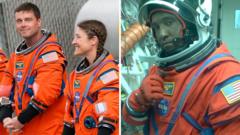
Many skeptics argue we’ve already done this. They think it's a rerun. They’re wrong. Artemis II isn't a nostalgia trip; it’s the stress test for a permanent presence on another world. The mission will take Reid Wiseman, Victor Glover, Christina Koch, and Jeremy Hansen on a ten-day journey that pushes the Orion spacecraft to its absolute limits. If you’re standing on the sand at Playalinda Beach, you aren't just watching a rocket launch. You’re watching the moment humanity stops visiting space and starts living there.
The SLS Is a Different Kind of Beast
You can’t compare the Space Launch System (SLS) to the Saturn V or even the Space Shuttle without acknowledging the raw, violent power of modern solid rocket boosters. The SLS produces 8.8 million pounds of thrust. That’s roughly 15% more power than the Saturn V. When that thing clears the tower, the sound doesn't just hit your ears—it vibrates your internal organs. It’s a physical event.
The people who traveled from across the globe to see this aren't just "space fans." They’re witnesses. They’re here because photos and 4K livestreams don't capture the way the horizon glows or the way the atmosphere seems to crack under the pressure of the ascent. NASA estimates that over 100,000 visitors have descended on Brevard County for this window. Hotels are packed. Traffic is a nightmare. Nobody cares. Because once those engines ignite, the inconvenience of a four-hour traffic jam on A1A vanishes.
Why We Are Going Back This Way
Artemis II is a flyby. It won't land. Some critics call that a missed opportunity, but they don't understand the engineering hurdles. Before you put boots on the lunar South Pole during Artemis III, you have to ensure the life support systems can handle the deep space radiation environment outside the protection of Earth's Van Allen belts. Orion is a tech-heavy capsule. It’s designed to be smarter, safer, and more autonomous than anything the Apollo era could have dreamed of.
Testing the Limits of Orion
The mission profile is aggressive. After reaching orbit, the crew will perform a series of maneuvers to test the spacecraft’s proximity operations. They’ll use the integrated power and propulsion of the SLS upper stage to practice docking-style movements. This isn't just "flying." It’s a carefully choreographed dance meant to prove that when it comes time to link up with a lunar lander or the future Gateway station, the hardware won't fail.
- Communication Lag: The crew will test high-bandwidth laser communications.
- Life Support: Monitoring how the cabin environment holds up with four humans breathing, sweating, and moving for 240 hours.
- Heat Shield Integrity: Re-entry will happen at 25,000 miles per hour. That’s Mach 32. The shield has to withstand temperatures near 5,000 degrees Fahrenheit.
The Human Factor on the Space Coast
Walking through the crowds near the Kennedy Space Center, you hear a dozen different languages. It’s a reminder that while NASA is leading the charge, this is an international effort. Jeremy Hansen represents Canada, marking the first time a non-American has left low Earth orbit. That matters. It shifts the narrative from a Cold War race to a global expansion.
I’ve talked to families who drove twenty hours just to sit in the humidity for a three-minute window of visibility. Why? Because space remains the only thing that actually makes us look up. In a world obsessed with tiny screens and local grievances, a Moon mission is a rare moment of collective awe. It’s a reset button for our perspective.
The Economic Engine of the Moon
Let’s be real. This isn't just about "the spirit of exploration." It’s about money and resources. The Artemis program is the foundation for a lunar economy. We’re looking at water ice in the shadowed craters of the Moon that can be turned into hydrogen fuel. We’re looking at Helium-3. The thousands of people watching this launch are seeing the first construction vehicles of a new industrial frontier.
If we don't go, someone else will. The lunar surface is the new "high ground." By establishing the Artemis Accords and pushing forward with this mission, the United States and its partners are setting the rules for how we’ll operate in the solar system. It’s about law, property rights, and safety.
What Happens After the Smoke Clears
Once Orion splashes down in the Pacific, the data will be pored over for years. Every vibration, every temperature spike, and every heartbeat of the crew will be analyzed. This isn't a one-off stunt. It’s the blueprint. If you want to see the future, stop looking at your phone and look at the launchpad.
The next step is the landing. Artemis III is already in the works. The hardware is being built. The suits are being tested. The momentum is finally real. If you’re looking to get involved, don't just watch the news. Track the mission through the NASA Eyes app or the Artemis Real-time Orbit Device (AROD). You can see exactly where the crew is in relation to the Moon. Understand the gravity of what they’re doing. They’re breaking the leash of Earth for the first time in half a century. Don't look away.
Check the local Florida weather patterns before the next launch window. Sea breezes often cause scrubbed launches, so have a backup plan for your viewing spot. Grab a high-quality pair of binoculars. You don't need a telescope to see the separation of the boosters, but you do need to be prepared for the sound. It arrives later than you expect. It starts as a low rumble and turns into a chest-thumping roar that stays with you forever.