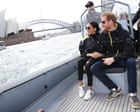
The modern evolution of the British Monarchy’s global influence is currently facing a structural challenge: the decoupling of royal symbolism from constitutional authority. Prince Harry and Meghan Markle’s recent international engagements, specifically their high-profile Australian tour, represent a strategic attempt to manufacture a "Shadow Sovereignty." This model replicates the logistical and visual signatures of a State Visit while operating entirely within the private sector. Analyzing this shift requires moving past the superficial labels of "faux royal" behavior and examining the precise mechanics of brand equity, diplomatic friction, and the economic conversion of inherited status.
The Mechanism of Visual Arbitrage
The Sussexes utilize a strategy best defined as Visual Arbitrage. This involves identifying the aesthetic and procedural hallmarks of official diplomatic missions—motorcades, high-level meetings with regional leaders, and curated public appearances—and applying them to non-state events. By mirroring these protocols, the Sussexes capture the "trust signals" associated with the Crown without the oversight of the Foreign, Commonwealth & Development Office (FCDO).
The logic follows a three-stage funnel:
- Protocol Emulation: Using security details, coordinated dress codes, and formal arrival ceremonies to signal importance.
- Access Conversion: Leveraging the "Prince" and "Duchess" titles to secure audience with elected officials who seek the halo effect of royal proximity.
- Narrative Monopolization: Distributing high-resolution, controlled imagery to global media outlets that crave "royal-adjacent" content, effectively crowding out official state messaging.
This creates a paradox for host nations. While the visit lacks official diplomatic status, the sheer scale of media attention forces local governments to treat it as a state event to manage public safety and political optics. This involuntary cooperation from the host state validates the "Shadow Sovereignty" model, creating a self-reinforcing loop of perceived authority.
The Depreciation of the Sovereign Halo
The primary asset being leveraged is the "Sovereign Halo"—the unearned but immense public interest and moral authority derived from the British Monarchy. However, the Shadow Sovereignty model operates under a unique set of economic pressures. Unlike the official Monarchy, which is funded through the Sovereign Grant and the Duchies, the Sussex brand must remain liquid to fund its high-burn-rate operational costs, including private security and global PR infrastructure.
This necessity leads to the Dilution Effect. Every time a royal title is used to promote a private venture, a Netflix docuseries, or a lifestyle brand like American Riviera Orchard, the scarcity value of that title decreases. In Australia, this was evidenced by the shift from public curiosity to "cosplay" criticism. When the visual signals of a royal tour are disconnected from the actual service-based duties of the Crown, the audience begins to perceive the performance as a product rather than a protocol.
Diplomatic Friction and the Two-Body Problem
The Sussexes’ Australian engagement highlights a "Two-Body Problem" in international relations. Australia, a Commonwealth realm currently debating its future as a constitutional monarchy, becomes a volatile testing ground for this shadow diplomacy.
From a structural standpoint, the Sussexes create a Diplomatic Bottleneck:
- Contradictory Signaling: If the Duke and Duchess champion causes that deviate from official UK government policy, it creates confusion regarding Britain's actual stance.
- Security Liability: Host nations are placed in a position where they must provide state-level security for private citizens to avoid the geopolitical catastrophe of a security breach involving a member of the British Royal Family.
- Political Fragmentation: Local politicians may use the Sussexes as a tool for republican sentiment, framing their "modernity" as an indictment of the "antiquated" official institution.
This creates a scenario where the Sussexes are effectively "disruptors" in the geopolitical market, using the branding of the legacy institution (the Monarchy) to undermine its traditional monopoly on diplomatic representation.
The Operational Cost of Private Diplomacy
Maintaining a global shadow court is capital-intensive. Without the institutional backstop of the Palace, the Sussexes must internalize costs that were previously externalized to the taxpayer.
The financial structure of these tours involves a complex mix of:
- Philanthropic Shielding: Using the Archewell Foundation as the formal vehicle for visits to provide a "charitable" justification for the travel and logistics.
- Content Extraction: The tour itself acts as a production set. The data gathered, the footage filmed, and the connections made are later processed into sellable media assets.
- Strategic Subsidization: Partnering with local organizations or high-net-worth individuals who cover ground costs in exchange for the prestige of hosting the couple.
The risk here is Operational Overreach. If the cost of maintaining the "royal" standard of living and security exceeds the revenue generated from media deals, the brand is forced into increasingly aggressive commercialization. This acceleration toward commercialism is exactly what triggers the "cosplay" critique, as the gap between the altruistic branding and the profit-seeking reality becomes too wide for the public to ignore.
Competitive Strategy and the Crown’s Response
The British Monarchy operates on a centuries-long time horizon. In contrast, the Sussex brand operates on the quarterly cycles of the attention economy. This fundamental difference in "Time Preference" gives the Crown a long-term advantage but leaves it vulnerable in the short-term media cycle.
The Palace’s strategy has shifted from active engagement to Institutional Silence. By not commenting on the "faux royal" tours, the Monarchy avoids validating them as a rival power center. Instead, they rely on the "Dignified vs. Efficient" framework famously described by Walter Bagehot. The Official Monarchy remains the "Dignified" part of the state, while the Sussexes, by engaging in the "Efficient" (and often messy) world of commercial media and celebrity activism, risk losing their Dignified status entirely.
The Fragility of the Expatriate Royal Model
The Sussexes’ strategy relies on a specific market condition: the American and international fascination with British royalty. However, this fascination is tied to the couple’s proximity to the throne. As the line of succession moves forward and the Prince and Princess of Wales’s children grow into their roles, the "relevance window" for a non-working Duke and Duchess narrows.
The Shadow Sovereignty model faces three terminal risks:
- The Novelty Decay: The public eventually tires of the "outsider royal" narrative once the initial shock of the exit fades.
- The Legitimacy Gap: As the Sussexes spend more time away from the UK, their cultural fluency with the institution they represent diminishes, making their "royal" actions feel increasingly performative and out of touch.
- The Succession Squeeze: New, active members of the Royal Family will eventually dominate the media space that the Sussexes currently occupy by default.
Strategic Optimization of Global Influence
To sustain their current trajectory, the Sussexes must pivot from Royal Mirroring to Autonomous Authority. The attempt to replicate the Australian tour's "royal" feel was a tactical error because it invited direct comparison to an institution that possesses superior resources and historical legitimacy.
A more sustainable model requires:
- Vertical Specialization: Deepening expertise in a single, high-impact area (e.g., veteran affairs or digital safety) rather than attempting the broad, generalist "handshaking" of a royal tour.
- Decoupling Protocol from Product: Reducing the reliance on motorcades and formal ceremonies to minimize the "cosplay" perception, focusing instead on quantifiable philanthropic outcomes.
- Geographic Diversification: Moving away from Commonwealth realms where the constitutional tension is highest, and focusing on markets where the "royal" tag is a curiosity rather than a political statement.
The Australian tour was not a failure of celebrity; it was a failure of brand positioning. By attempting to be "royal" without being "the Monarchy," the Sussexes created a product that reminds the consumer of the original while highlighting the absence of its core substance. The path forward necessitates a brutal choice: either commit fully to the celebrity-influencer industrial complex or find a way to perform genuine public service that does not require the aesthetic scaffolding of the institution they left behind.
The "Shadow Sovereignty" model is currently in a state of high-beta volatility. While it generates massive short-term attention, it lacks the institutional stability required for long-term survival. The coming years will determine if the Sussexes can transform their inherited fame into a distinct, autonomous power base or if they will remain a high-budget tributary of the very institution they sought to disrupt.